Space sector seeking to contribute more to national development

PSNews - Relevant agencies should promote close and good coordination in exploiting the remote sensing satellite imaging system to effectively monitor environment, natural resources, climate change, and natural disasters, contributing to national development.

Since its first satellite was launched in 2013, Vietnam has focused on applying remote sensing satellite imaging to socio-economic development.

According to the National Satellite Center, so far 1,420 satellites have been launched into space by countries all over the world for different purposes, including 360 Earth observation satellites. The United States operates 43 earth observation satellites, China has 40 while Japan runs 18.
Since its first satellite was launched in 2013, Vietnam has focused on applying remote sensing satellite imaging to socio-economic development.

The number of earth observation satellites has increased since 2000, which has led to an idea that countries are on a race of satellite technology with the aim of collecting more data for socio-economic development as well as defense and security.

In Vietnam, the space technology was started in the late 1970s when preparing for the flight into the space of the first Vietnamese citizen, hero Pham Tuan, in 1980.

However for a number of reasons, some projects on space technology were cancelled.

Efforts for researching and applying space technology were not renewed until 2006 or 25 years later, when the Prime Minister adopted the National Strategy for Research and Applications of Space Technology.

Since then, along with the construction of technical infrastructure for the Vietnam Space Centre in Hoa Lac, and launching small satellites into space, Vietnam has been investing in developing human resources for space technology and cosmology; researching and manufacturing satellites; and promoting the application of satellite imaging data to socio-economic development. Today,

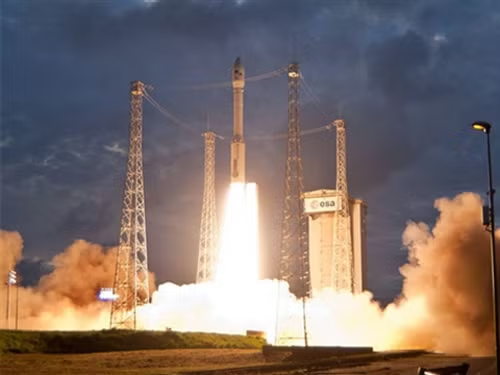
After years of preparation, Vietnam’s first remote sensing satellite, VNRED Sat-1, was launched by Arianespace from the Guiana Space Center, French Guiana on May 2013. Since then, VNRED Sat-1 has stably operated in the orbit and transferred many pictures to the ground stations.

According to Dr. Bui Trong Tuyen, Director of the Institute of Space Technology, over the past 3 years operating in the orbit, VNRED Sat- 1 has taken 58,000 landscape photographs, including 31,480 photos of Vietnam’s territorial areas; 23,300 photo of different areas all over the world.

The first Vietnamese earth observation satellite has provided ministries, branches and localities with 14000 high-resolution satellite images, serving territory management and natural disaster detection, environmental protection and climate change phenomena.

However, the use of satellite data has been limited; and as a result, Vietnam has still had to purchase a number of images from other countries at high prices. Moreover, the lifespan of VNREDsat-1 is only 5-7 years.

Against this backdrop, the Vietnam Science and Technology Academy has been assigned to cooperate with its Japanese partner to manufacture and launch a satellite of LOTUsat-1 that can take images in all weather conditions, by 2019.

The combination of the two kinds of satellites is expected to bring about good outcomes, contributing more to national socio-economic development.

There still remain questions, such as how to integrate infrastructure on ground and satellites, and how to promote good coordination among the Vietnam Science and Technology Academy, the National Remote Sensing Department and other relevant agencies and organizations, so as to exploit and apply satellite data to national socio-economic development effectively and efficiently.
By Phung Nguyen

Other News

SK Group partners to build AI ecosystem in Vietnam

SK Group partners to build AI ecosystem in Vietnam

SK Innovation and SK Telecom signed MoUs with Nghe An province and the National Innovation Centre of Vietnam to advance AI ecosystem development and support the country’s long-term growth strategy.

Vietnam Research Excellence Fellowship for 2026-2030 approved

Vietnam Research Excellence Fellowship for 2026-2030 approved

Under the Vietnam Research Excellence Fellowship (VREF) for the 2026–2030 period, PhD students are identified as a core research force directly contributing to breakthroughs in sci-tech and innovation. Investing in top-tier doctoral candidates is more than workforce development, but a high-stakes strategic bet to forge a cohort of world-class scientists and technologists who can power Vietnam’s long-term economic ambitions.

Strategic tech must address practical challenges: PM

Strategic tech must address practical challenges: PM

Prime Minister Pham Minh Chinh on March 28 said strategic technologies must tackle Vietnam’s practical challenges, while chairing a meeting of the Government’s Steering Committee for science and technology, innovation, digital transformation, and Project 06.

Ho Chi Minh City sets sights on becoming semiconductor hub

Ho Chi Minh City sets sights on becoming semiconductor hub

Ho Chi Minh City is stepping up efforts to attract investment from global leading groups and companies in the fields of electronic components, semiconductors and chip manufacturing as it seeks to position itself as a leading semiconductor industry hub in both the region and the world. 

Ho Chi Minh City launches upgraded technology exchange platform

Ho Chi Minh City launches upgraded technology exchange platform

The upgraded platform represents a comprehensive shift from a simple information-sharing model to a managed online technology trading system, enabling monitoring and measurement of real transaction outcomes. It is built on three pillars, namely new tradable technology products, a modern digital platform, and an improved operational model.

AI – unmissable opportunity for Vietnam: Experts

AI – unmissable opportunity for Vietnam: Experts

AI also emerges as a key enabler for Vietnam's ambition to build financial and technology hubs. Applications can boost efficiency, automate workflows, cut costs, and sharpen data analytics, which are essential pillars of a modern financial system.

PM calls for accelerated space technology development in Vietnam

PM calls for accelerated space technology development in Vietnam

Vietnam aims by 2030 to achieve a mid-level position in space science and technology development within Southeast Asia, and after 2030 to build national capabilities to independently develop satellite technologies and apply space data to address global challenges and national security needs.

High-level forum advances Vietnam–US technological cooperation

High-level forum advances Vietnam–US technological cooperation

A high-level executive leadership forum focusing on strengthening Vietnam - US relations through technology cooperation was jointly held in Washington D.C. on March 11 by the Embassy of Vietnam in the US, the Weatherhead East Asian Institute of Columbia University, and the US -ASEAN Business Council (USABC). 

AI Law takes effect, anchors national governance framework

AI Law takes effect, anchors national governance framework

While many countries are still drafting policy blueprints or issuing non-binding guidance, Vietnam has moved ahead with a standalone Law on Artificial Intelligence (AI), effective from March 1, placing it among a select group of nations to adopt dedicated AI legislation at the parliamentary level. 

Vietnam International Defence Expo 2026 preparations move into high gear

Vietnam International Defence Expo 2026 preparations move into high gear

Vietnam International Defence Expo 2026, themed “Peace, Friendship, Cooperation and Development,” will be organised on a larger scale, featuring a wide array of weapons and technical equipment alongside product exhibitions, seminars and panel discussions, drills, live field demonstrations, and business networking activities.

Ministry requests urgent measures to counter UAVs threatening aviation safety

Ministry requests urgent measures to counter UAVs threatening aviation safety

Ministry of Construction requested the Ministry of National Defence, the Ministry of Public Security and provincial and municipal steering committees for counter-terrorism to strengthen the management, inspection and supervision of UAVs and other aerial devices, ensuring strict compliance with Decree No. 288/2025/ND-CP and relevant legal regulations.