Sweden rebuilds Cold War missile system from museums

Sweden has reconstituted its old Cold War anti-ship defence system, pulling launch trucks out of museums, in its latest move to improve its defences on the island of Gotland.

The Kustrobotbatteri 90 was the only land-based launcher ever developed for the Saab Robotsystem 15 (RBS-15) anti-ship missiles, but only one of the four planned batteries was delivered before the coastal artillery was disbanded in 2000. 

“We analysed whether we would be able to put something back together again which was capable of launching with,” Rear Admiral Thomas Engevall told Sweden’s Dagens Nyheter newspaper. 

The RBS-15 missiles were launched from Scania trucks, several of which have now been recovered from museums. 

“A number of the trucks still remained. We have have taken components from existing missile boats and warships which had the same missile system,” Engevall added.  
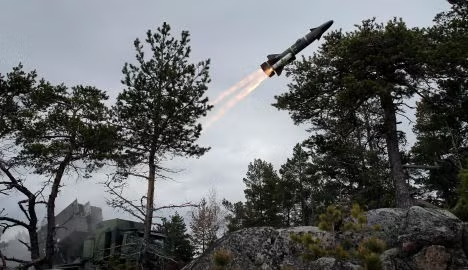
Mike Winnerstig, security policy analyst at the Swedish Defence Research Agency, said that the decision showed that Sweden was stepping up its defence capabilities. 

“This decision is national, but it is also a contribution by Sweden to the international defence capability in the Baltic Sea after Russia's annexation of Crimea and the invasion of Ukraine,” he said. “If you group together these kinds of systems on Gotland, you can control quite a lot of territory in the mid-Baltic.” 

“I do not think Sweden is a primary goal for Russia,” he added. “But we would still be involved in any conflict in the Baltic Sea area related to EU countries.” 

Defence minister Peter Hultqvist on Friday visited the test site on Sweden's east coast where the reconstituted system is being put through its paces.  

“It is extremely good that we have land-based coastal missile systems back in our National Defence,” he said. “It means that we can shoot anti-ship missiles from land over great distance. They provides increased flexibility and capability in marine warfare. It increases military capability and that’s something we need.” 

He said that SAAB had worked closely with the Swedish armed forces to  put the system back together.  

Mikael Oscarsson, defence spokesman for the opposition Christian Democrats said he aimed to convince the Swedish parliament to reverse a decision to scrap the ArtE 740 radar, which could be used together with the missile system. 

“If you also used the ArtE 740 mobile radar stations there would be a system that is not dependent on vulnerable fixed radar stations and data from ships,” he said. 

The Local Sweden

Other News

AI offers both opportunities, challenges for Vietnam's growth

AI offers both opportunities, challenges for Vietnam's growth

Dr. Ho Duc Thang, a full-time member of the National Assembly’s Committee for Cultural and Educational, said productivity is the key to sustaining double-digit economic growth, and AI has greater potential to improve productivity than any previous technology.

Top leader unveils people-centred vision for new development model

Top leader unveils people-centred vision for new development model

Vietnam's growth model, long fueled by low-cost labour, resource extraction, contract manufacturing, expanded investment, and capital accumulation, has run out of road. The country now needs a sweeping reform agenda to shift from extensive growth to a model driven by productivity, knowledge, science and technology, innovation, and digital transformation.

First national semiconductor chip prototyping support centre makes debut

First national semiconductor chip prototyping support centre makes debut

Vietnam's semiconductor ecosystem now comprises around 60 chip design companies, some 7,000 chip design engineers and 166 universities offering semiconductor-related training programmes. Initial registrations from 12 organisations indicate demand for the prototyping of approximately 30,000 chips.

Vietnam targets at least 10 large strategic technology firms by 2030

Vietnam targets at least 10 large strategic technology firms by 2030

Deputy Prime Minister Ho Quoc Dung has signed a decision approving a plan to develop large domestic strategic technology enterprises in the 2026–2030 period, aimed at advancing digital infrastructure, digital human resources, digital data, strategic technologies and cybersecurity.

Protecting users crucial in building digital trust: Experts

Protecting users crucial in building digital trust: Experts

In Vietnam, digital transformation in the finance and banking sector is accelerating cashless payments, expanding access to financial services, improving market transparency and supporting economic growth and macroeconomic management.

Fostering skilled workforce for innovation era: experts

Fostering skilled workforce for innovation era: experts

Experts said close coordination among State management agencies, research institutes, universities, and businesses will improve training quality and serve the dual goals of quality education and practical research application.

Startup forum bridges Silicon Valley and local innovation ecosystem

Startup forum bridges Silicon Valley and local innovation ecosystem

The University of Economics Ho Chi Minh City (UEH), Saigon Asset Management (SAM), and Plug and Play Tech Centre co-hosted the “From Vietnam to Silicon Valley” forum, exploring AI innovation, venture capital, and pathways to integrate Vietnam’s startup ecosystem with Silicon Valley and global markets.