Tesla debuts $35,000 Model 3, sees loss in first quarter

Tesla Inc said on Thursday it would not be profitable in the first quarter, as it offered for the first time a $35,000 version of its Model 3 sedan and said its global sales would now be online-only, steps designed to increase demand and cut overhead costs for the electric vehicle maker.

Chief Executive Elon Musk’s warning on profit during a conference call with members of the media, which did not include Reuters, contrasted with Tesla’s statements last month that it was expecting a “very small” net profit in the first quarter.

Shares of Tesla fell 3.4 percent after hours. Investors have voiced concerns about whether Tesla would be able to maintain profit margins through cost cutting - such as recent layoffs - as it reduces prices of its newest vehicle.

A Tesla Model 3 sedan is displayed during its launch in Hawthorne

Still, the price drop could quell concerns from some analysts that demand for the higher-priced versions of the Model 3 was beginning to dry up in the United States, especially after a federal tax credit was cut in half this year.

“Tesla wants to drum up demand,” said Elazar Advisors’ Chaim Siegel. “There was a slowdown in the U.S. as the tax credits dropped. (There are) more tax credit hits later in the year too so they are trying to be proactive.”

Musk has often shared that his strategy for Tesla was to build higher-priced cars - the Model S and X - whose success would ultimately usher in a $35,000 mass-market car, followed by an SUV, the Model Y, which is currently in development. But customers who reserved the Model 3 at that lower price have waited nearly three years since Musk first promised it.

An online-only sales strategy, along with other changes, would allow vehicle prices to fall by about 6 percent on average, Tesla said in a blog on its website bit.ly/2IHjLw4. Over the next few months, Tesla will wind down "many" of its stores, while investing in its service system, it said.

Online-only sales represent a dramatic shift for the company that has prided itself on its boutique retail stores. In June 2017, Musk pledged to increase the number of stores, saying they had “barely touched the surface” of what was possible.

As of the fourth quarter, Tesla said it recently opened 27 new locations, bringing its total of stores and service centers to 378.

Reuters

Other News

Hanoi approves controlled pilot of two technology projects

Hanoi approves controlled pilot of two technology projects

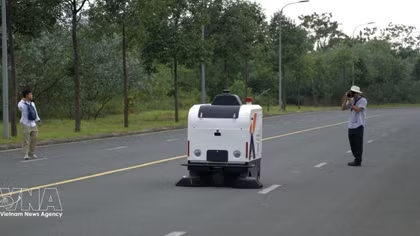
The two projects involve an intelligent autonomous transportation system developed by Phenikaa-X JSC and a technology for producing mixed rare-earth oxides with a purity of over 95% on a semi-industrial scale developed by the Mining Technology and Construction Consultancy JSC.

Banking industry in AI era: When data becomes competitive advantage

Banking industry in AI era: When data becomes competitive advantage

In just a few years, AI has evolved from an experimental technology into an “assistant” for many banks, supporting everything from customer service, credit approval, and fraud detection to risk management. However, as the technological gap between institutions narrows, a new question is emerging: What will determine banks' competitive advantage in the AI era?

Bac Ninh considers establishing AI centre of excellence

Bac Ninh considers establishing AI centre of excellence

A meeting has been held in Bac Ninh to discuss potential cooperation with Plug and Play in developing the northern province’s innovation ecosystem and establishing an artificial intelligence (AI) centre of excellence, with Standing Vice Chairman of the provincial People’s Committee Mai Son receiving a delegation from the global innovation platform.

Hanoi allows 24-month trial of autonomous vehicles at Hoa Lac

Hanoi allows 24-month trial of autonomous vehicles at Hoa Lac

The project aims to assess the safety, reliability and readiness of autonomous vehicles under real traffic conditions, as well as the effectiveness of autonomous public transport and compatibility with existing systems. Its results will contribute to developing technical standards, operating procedures and management models suited to Hanoi’s traffic conditions.

Singapore's experience suggests solutions to Vietnam's human resources challenge in AI era

Singapore's experience suggests solutions to Vietnam's human resources challenge in AI era

As Vietnam accelerates digital transformation and high-tech development, Singapore’s experience and the engagement of global technology companies demonstrate that human resources preparation must stay ahead of the curve. The ability to filter knowledge, collaborate, innovate and effectively use AI will increasingly become essential to helping workers adapt to a changing labour market and strengthening the competitiveness of Vietnam’s economy in the new era.

Protecting national security amid digital transformation, cyberspace

Protecting national security amid digital transformation, cyberspace

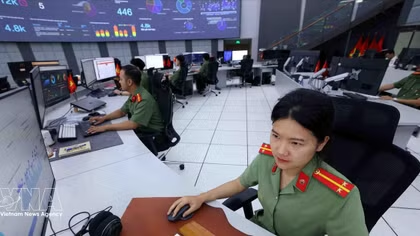
Cybersecurity, information security and data security risks must be identified and addressed early and from afar, with appropriate defensive measures ready to neutralise threats and protect national interests in cyberspace, said Lieutenant General Le Xuan Minh, Director of the Ministry of Public Security’s Department of Cybersecurity and Hi-tech Crime Prevention (A05).

Mekong Delta launches first robotics, AI research institute

Mekong Delta launches first robotics, AI research institute

Dr. Nguyen Van Quang, Rector of Nam Can Tho University, said the university is developing a value chain covering training, research, technology development, testing, technology transfer and commercialisation. The model is designed to link research more closely with practical needs, ensuring that technologies generate products and products create value for society.

Vietnam positioned to harness AI wave, World Bank report says

Vietnam positioned to harness AI wave, World Bank report says

The WB report identifies Vietnam as one of the few economies outside the European Union (EU) to have adopted a comprehensive AI regulatory framework as early as 2025. Vietnam applies a risk-tiered approach similar to that of the EU AI Act, imposing different obligations depending on whether an AI system poses “unacceptable,” “high,” “low” or “minimal” risks. The approach is viewed as a strategic step towards ensuring safe and transparent AI governance.

AI offers both opportunities, challenges for Vietnam's growth

AI offers both opportunities, challenges for Vietnam's growth

Dr. Ho Duc Thang, a full-time member of the National Assembly’s Committee for Cultural and Educational, said productivity is the key to sustaining double-digit economic growth, and AI has greater potential to improve productivity than any previous technology.

Top leader unveils people-centred vision for new development model

Top leader unveils people-centred vision for new development model

Vietnam's growth model, long fueled by low-cost labour, resource extraction, contract manufacturing, expanded investment, and capital accumulation, has run out of road. The country now needs a sweeping reform agenda to shift from extensive growth to a model driven by productivity, knowledge, science and technology, innovation, and digital transformation.