Not since the retirement of Nasa’s space shuttle fleet in 2011 has the US possessed the capability to send its own astronauts into orbit, and the success of this week’s mission, formally known as SpaceX Demo-2, is likely to shape the direction of the space agency’s near-Earth ambitions for a generation.
At 4.33pm, a Dragon crew capsule attached to a Falcon 9 rocket is set to take flight from the Kennedy Space Center at Cape Canaveral, bound for the international space station (ISS). It will carry two Americans as test pilots, both veterans of previous space shuttle missions. They will remain there for up to three months while mission managers evaluate the spaceship’s performance.
The hardware was built by SpaceX, the private California-based company founded by the controversial billionaire entrepreneur Elon Musk, and funded by the US government under Nasa’s Commercial Crew Program (CCP).
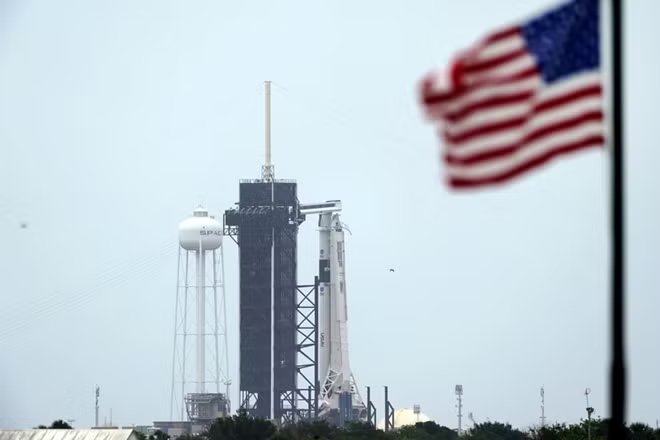 |
| The SpaceX Falcon 9, with the Crew Dragon spacecraft on top of the rocket, sits on Launch Pad 39-A on Monday at Kennedy Space Center. Photograph: David J Phillip/AP |
While every previous US space program was a government venture, Nasa signaled a switch of direction in 2010 with the initiative to subcontract low Earth orbit operations to private industry while concentrating its own efforts on longer-term goals, such as returning to the moon by 2024.
In a symbolic nod to the new world order, the astronauts Bob Behnken and Doug Hurley will ride to the launchpad in an electric car manufactured by Tesla, another of Musk’s pioneering companies, foregoing the “tin-can” Astrovan that has been the traditional crew transport since the US began sending humans into space in 1961.
“We are on the cusp of launching American astronauts on American rockets from American soil yet again,” said Jim Bridenstine, the Nasa administrator, who referred to Wednesday’s planned launch as “the big show”.
“This time we’re doing it differently than we’ve ever done it before. Nasa is not going to purchase, own and operate the hardware the way we used to. We are partnering with commercial industry with the intent that they would go get customers that are not Nasa, drive down our costs and increase the access to space.”
According to the Planetary Society, Nasa has invested $6.2bn in CCP since 2010, making it the lowest-cost human spaceflight development effort in almost 60 years. The money has been mostly split two ways, to SpaceX and its rival Boeing, whose uncrewed test flight of the Starliner human-rated capsule ended in partial failure in December, pushing back its next launch attempts to 2021.
SpaceX, which has been ferrying cargo to the ISS since 2012 under a separate freight contract with Nasa, has had to overcome challenges of its own. A Crew Dragon capsule was destroyed in a ground test explosion at Cape Canaveral in April 2019, and in 2015, a Falcon rocket carrying supplies to the ISS exploded 139 seconds into flight.
“Spaceflight is not easy. They’ve had hiccups along the way and they’ve overcome them,” said Dr Henry Hertzfeld, director of the Space Policy Institute at George Washington University’s Elliott School of International Affairs.
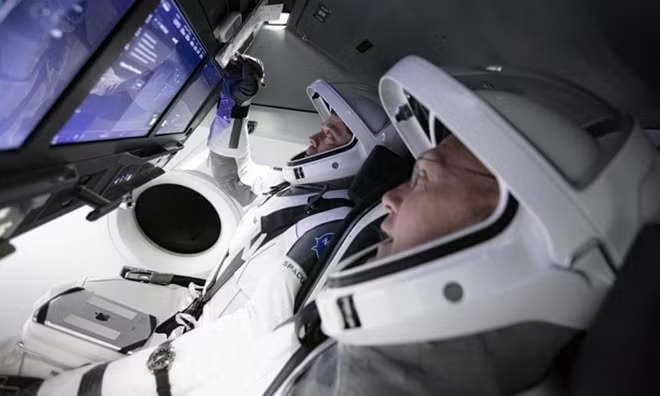 |
| Doug Hurley, foreground, and Bob Behnken work in SpaceX’s flight simulator at the Kennedy Space Center in Cape Canaveral, Florida. Photograph: AP |
“They’ve done quite well. They’ve been in existence 20 years, so not quite your startup at this point. They have a younger, more energetic workforce along with hiring some very good, experienced people, most having cut their teeth on government programs, be it Nasa or defense programs.
“[But] the test is yet to come. One hopes it is significant, in the sense that the government put its money elsewhere. To me it hasn’t been the capability of getting to space that we’ve been lacking, it’s the extra money that human spaceflight requires. Even before the shuttle was retired there were other programs that we never completed that were government programs with human spaceflight in mind.”
The cancellation of the workhorse shuttle program in 2011, after 30 years of flight and punctuated by two disasters that cost 14 astronauts their lives and lost the orbiters Challenger and Columbia, marked dark days for the space industry. More than 10,000 jobs were lost, and the economy around the Florida space center tanked, despite Nasa’s continuing robotic exploratory missions to Mars and beyond.
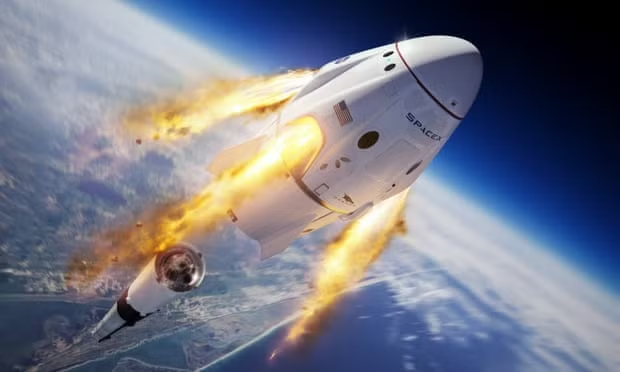 |
| An illustration shows the Crew Dragon capsule and Falcon 9 rocket. Photograph: SpaceX/AP |
With each astronaut’s seat on Russian Soyuz spacecraft to the ISS costing the US government up to $85m, some even feared for the future of Nasa itself. In recent years the industry has become resurgent, with entrepreneurs such as Musk; Amazon’s Jeff Bezos, through his Blue Origin operations; and Virgin Galactic’s Richard Branson fuelling a building boom at Cape Canaveral and elsewhere.
Blue Origin and Virgin are pursuing the space tourism market, while expanding ambitions in other directions: for example, a team including Blue Origin was selected in April to begin development of a lander capable of returning humans to the moon under Nasa’s Artemis program, while Virgin Orbit, a Branson offshoot, was planning the first test flight of its airborne rocket launch system LauncherOne this week.
Donald Trump, who has made American spaceflight a policy priority through the foundation of the Space Force as the sixth branch of the US military, and an ambitious order to Nasa to make the first crewed moon landing since 1972 within the next four years, will attend Wednesday’s launch.
Coronavirus, however, has led to Nasa urging the public to watch on television from home to avoid large crowds gathering on beaches and causeways near the space center. The agency has set up a website, Launch America, to enhance the experience.
“This is a moment when we can all look and be inspired,” Bridenstine said. “We have a moment in time when we don’t just have to reflect on how difficult things are right now, we can talk about how bright things are going to be in the future.