U.S.-Russian crew lands in Kazakhstan after 172 days in space

A U.S. astronaut and two Russian cosmonauts wrapped up a 172-day mission aboard the International Space Station with a parachute descent and landing at dawn on the steppes of Kazakhstan, a NASA TV broadcast showed.

The capsule made a parachute descent southeast of Zhezkazgan, disappearing into a layer of haze as it neared the ground.

It was several minutes until NASA could confirm the landing at 7:13 a.m. local time on Wednesday (9:13 p.m. EDT on Tuesday/0113 GMT on Wednesday).
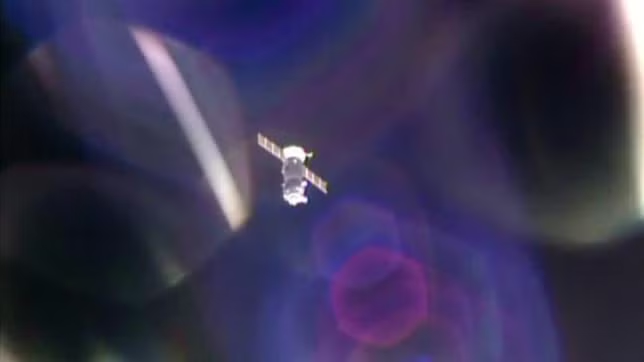
The Soyuz TMA-20M spacecraft is seen departing from the International Space Station in a still frame from NASA TV video September 6, 2016. NASA TV/Handout via Reuters

Station commander Jeff Williams, with the U.S. space agency, and flight engineers Alexey Ovchinin and Oleg Skripochka, both with Russia's Roscosmos agency, pulled away from the space station at 5:51 p.m. EDT/2151 GMT as the ships sailed 258 miles (415 km) over eastern Mongolia, said NASA mission commentator Rob Navias.

"I will certainly miss this view!" Williams tweeted earlier on Tuesday, posting a picture of sunlight glinting off the planet.

"Vast gratitude toward my crewmates, ground teams, supporting friends, and family," Williams added.

Williams, 58, returns to Earth with a career total of 534 days in orbit, more time than any other astronaut in U.S. history and 14th in the world.The mission comes the same day a U.S. space probe was cleared for launch on Thursday to collect and return samples from an asteroid in hopes of learning more about the origins of life on Earth and perhaps elsewhere in the solar system, NASA said.

The Russians remain champions of long-duration spaceflight, with cosmonaut Gennady Padalka currently the world record-holder with 878 days in space over five missions.

Before leaving the station, Williams turned over command of the $100 billion outpost, a project of 15 nations, to cosmonaut Anatoly Ivanishin, who remains aboard the station with NASA astronaut Kate Rubins and Japan's Takuya Onishi.

"We'll be missing you here," Ivanishin said during a change-of-command ceremony on Monday. "Have fun riding though the atmosphere ... and have a very safe and exceptionally soft landing."

A replacement crew is due to launch on Sept. 23 from the Baikonur Cosmodrome in Kazakhstan.
Source: Reuters

Other News

Hanoi approves controlled pilot of two technology projects

Hanoi approves controlled pilot of two technology projects

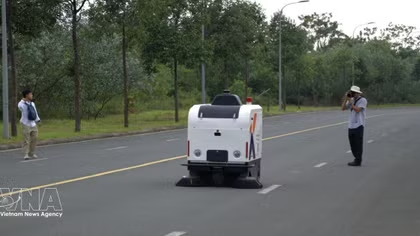
The two projects involve an intelligent autonomous transportation system developed by Phenikaa-X JSC and a technology for producing mixed rare-earth oxides with a purity of over 95% on a semi-industrial scale developed by the Mining Technology and Construction Consultancy JSC.

Banking industry in AI era: When data becomes competitive advantage

Banking industry in AI era: When data becomes competitive advantage

In just a few years, AI has evolved from an experimental technology into an “assistant” for many banks, supporting everything from customer service, credit approval, and fraud detection to risk management. However, as the technological gap between institutions narrows, a new question is emerging: What will determine banks' competitive advantage in the AI era?

Bac Ninh considers establishing AI centre of excellence

Bac Ninh considers establishing AI centre of excellence

A meeting has been held in Bac Ninh to discuss potential cooperation with Plug and Play in developing the northern province’s innovation ecosystem and establishing an artificial intelligence (AI) centre of excellence, with Standing Vice Chairman of the provincial People’s Committee Mai Son receiving a delegation from the global innovation platform.

Hanoi allows 24-month trial of autonomous vehicles at Hoa Lac

Hanoi allows 24-month trial of autonomous vehicles at Hoa Lac

The project aims to assess the safety, reliability and readiness of autonomous vehicles under real traffic conditions, as well as the effectiveness of autonomous public transport and compatibility with existing systems. Its results will contribute to developing technical standards, operating procedures and management models suited to Hanoi’s traffic conditions.

Singapore's experience suggests solutions to Vietnam's human resources challenge in AI era

Singapore's experience suggests solutions to Vietnam's human resources challenge in AI era

As Vietnam accelerates digital transformation and high-tech development, Singapore’s experience and the engagement of global technology companies demonstrate that human resources preparation must stay ahead of the curve. The ability to filter knowledge, collaborate, innovate and effectively use AI will increasingly become essential to helping workers adapt to a changing labour market and strengthening the competitiveness of Vietnam’s economy in the new era.

Protecting national security amid digital transformation, cyberspace

Protecting national security amid digital transformation, cyberspace

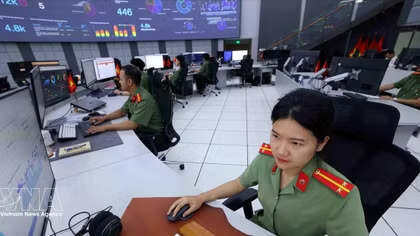
Cybersecurity, information security and data security risks must be identified and addressed early and from afar, with appropriate defensive measures ready to neutralise threats and protect national interests in cyberspace, said Lieutenant General Le Xuan Minh, Director of the Ministry of Public Security’s Department of Cybersecurity and Hi-tech Crime Prevention (A05).

Mekong Delta launches first robotics, AI research institute

Mekong Delta launches first robotics, AI research institute

Dr. Nguyen Van Quang, Rector of Nam Can Tho University, said the university is developing a value chain covering training, research, technology development, testing, technology transfer and commercialisation. The model is designed to link research more closely with practical needs, ensuring that technologies generate products and products create value for society.

Vietnam positioned to harness AI wave, World Bank report says

Vietnam positioned to harness AI wave, World Bank report says

The WB report identifies Vietnam as one of the few economies outside the European Union (EU) to have adopted a comprehensive AI regulatory framework as early as 2025. Vietnam applies a risk-tiered approach similar to that of the EU AI Act, imposing different obligations depending on whether an AI system poses “unacceptable,” “high,” “low” or “minimal” risks. The approach is viewed as a strategic step towards ensuring safe and transparent AI governance.

AI offers both opportunities, challenges for Vietnam's growth

AI offers both opportunities, challenges for Vietnam's growth

Dr. Ho Duc Thang, a full-time member of the National Assembly’s Committee for Cultural and Educational, said productivity is the key to sustaining double-digit economic growth, and AI has greater potential to improve productivity than any previous technology.

Top leader unveils people-centred vision for new development model

Top leader unveils people-centred vision for new development model

Vietnam's growth model, long fueled by low-cost labour, resource extraction, contract manufacturing, expanded investment, and capital accumulation, has run out of road. The country now needs a sweeping reform agenda to shift from extensive growth to a model driven by productivity, knowledge, science and technology, innovation, and digital transformation.