Vietnam to develop space technology for climate change

PSNews - Under the Master plan for Space technology named “The Strategy for Research and Application of Space Technology Towards 2020” which declared that Vietnam would own satellites made in Vietnam by 2020, the GOV officially decided to implement the Project on “Disaster and Climate Change Countermeasures Using Earth Observation Satellite” as a core project to realize the strategy. 

The Project is funded by Japanese Yen Loan, with Vietnam Academy of Science and Technology (VAST) as the line agency and Vietnam National Space Center (VNSC) as implementing agency.

Under this Project, radar sensor observation satellites with proven concept are manufactured and launched into the orbit. This proven technology can be applied to other types of satellites such as communications, navigation and scientific research missions in the future. 

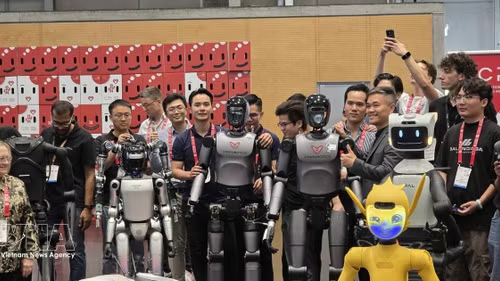
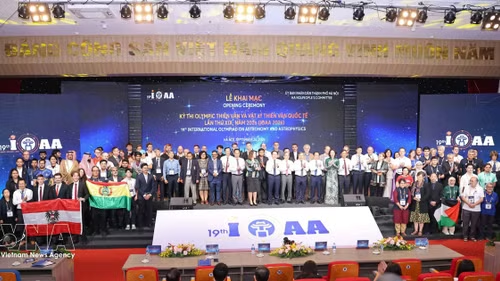
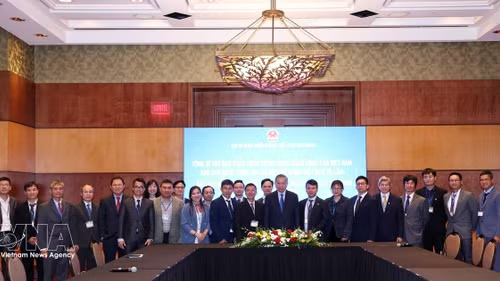
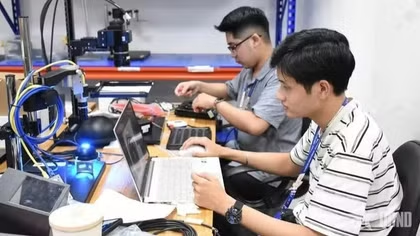
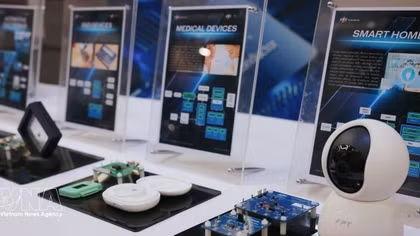
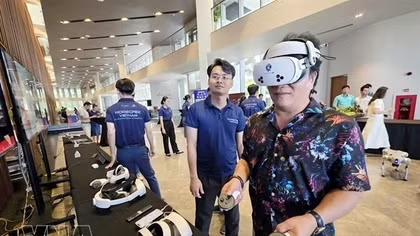
Photo for illustration.
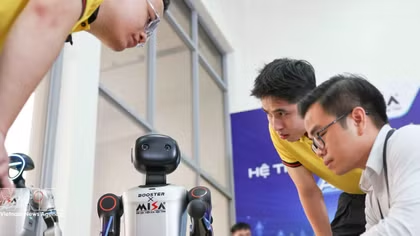
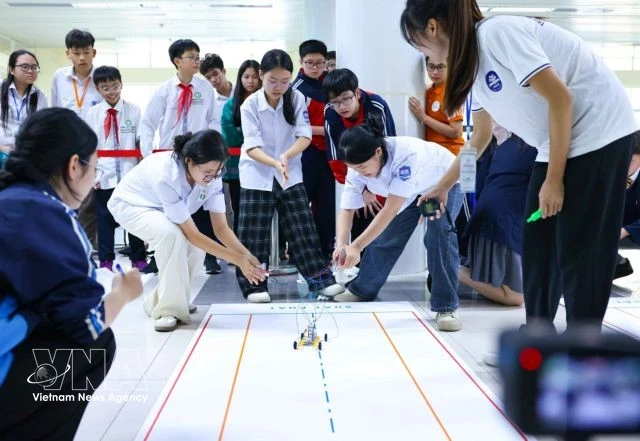
Photo for illustration. 

The satellite employs the actual achievements of Japanese space industry with the most up-to-date technology for the radar sensor and cost efficiency. This concept best matches the plans and prospects of Vietnam, and also would contribute to industry 4.0.

Upon the above satellite launching into orbit, Vietnam will be able to much shorten the duration to get satellite images from 16 hours as it is now to 6 hours. Also, it would help Vietnam flexibly and properly get satellite images in much wider areas including oceans. The ownership of those satellites enables Vietnam to take satellite images, upon request by end- users with much higher resolution of 1m, as compared with the average resolution of 5m.

Vietnam is a narrow and long country lying along a north/south axis with multitudinous climatic and geological conditions. Besides, environmental damage due to oil leakage from oil tanker accidents along the coast occurs frequently, resulting in heavy impacts to fisheries. Losses from these natural disasters and man-made disasters took up nearly 1.5% of Vietnam’s GDP every year. 

It is an urgent issue for Vietnam to establish and operate infrastructure to continuously obtain satellite remote sensing data to monitor natural disasters, which would improve and formulate an early warning system to minimize climate change impacts and natural disaster aftermaths and to manage the country’s natural resources and environment.

The Project is in accordance with the science and technology cooperation, which recognizes the space technology industry as a prioritized area and is mentioned in the joint statement of Japanese Prime Minister Shinzo Abe (at the time of the statement) and Vietnamese Prime Minister Nguyen Tan Dung (at the time of the statement) in October 2006. After that preparatory survey was conducted by JICA and the loan agreement was signed in 2011 by the government of Vietnam and JICA.
PSNews

Other News

Vietnam targets at least 10 large strategic technology firms by 2030

Vietnam targets at least 10 large strategic technology firms by 2030

Deputy Prime Minister Ho Quoc Dung has signed a decision approving a plan to develop large domestic strategic technology enterprises in the 2026–2030 period, aimed at advancing digital infrastructure, digital human resources, digital data, strategic technologies and cybersecurity.

Protecting users crucial in building digital trust: Experts

Protecting users crucial in building digital trust: Experts

In Vietnam, digital transformation in the finance and banking sector is accelerating cashless payments, expanding access to financial services, improving market transparency and supporting economic growth and macroeconomic management.

Fostering skilled workforce for innovation era: experts

Fostering skilled workforce for innovation era: experts

Experts said close coordination among State management agencies, research institutes, universities, and businesses will improve training quality and serve the dual goals of quality education and practical research application.

Startup forum bridges Silicon Valley and local innovation ecosystem

Startup forum bridges Silicon Valley and local innovation ecosystem

The University of Economics Ho Chi Minh City (UEH), Saigon Asset Management (SAM), and Plug and Play Tech Centre co-hosted the “From Vietnam to Silicon Valley” forum, exploring AI innovation, venture capital, and pathways to integrate Vietnam’s startup ecosystem with Silicon Valley and global markets.

Experts call for stronger action against fake news online

Experts call for stronger action against fake news online

Experts have warned that fake news, misinformation and harmful online content are increasingly shaping public perceptions, particularly among young people, and stressed the need for stronger legal safeguards, technology tools and wider dissemination of credible information to tackle the problem effectively.

Protecting digital future in post-quantum, AI era

Protecting digital future in post-quantum, AI era

Participants highlighted the importance of building a proactive, synchronised and sustainable national cybersecurity ecosystem through closer cooperation among regulators, technology firms, research institutions and cybersecurity experts.

Vietnam attends SAHA 2026 defence, aerospace exhibition in Türkiye

Vietnam attends SAHA 2026 defence, aerospace exhibition in Türkiye

Vietnam’s participation in SAHA 2026 International Defence & Aerospace Exhibition in Istanbul reflects the country’s consistent policy of enhancing international defence integration and promoting defence industry cooperation towards self-reliance, self-strengthening, modernisation and dual-use development.

SK Group partners to build AI ecosystem in Vietnam

SK Group partners to build AI ecosystem in Vietnam

SK Innovation and SK Telecom signed MoUs with Nghe An province and the National Innovation Centre of Vietnam to advance AI ecosystem development and support the country’s long-term growth strategy.

Vietnam Research Excellence Fellowship for 2026-2030 approved

Vietnam Research Excellence Fellowship for 2026-2030 approved

Under the Vietnam Research Excellence Fellowship (VREF) for the 2026–2030 period, PhD students are identified as a core research force directly contributing to breakthroughs in sci-tech and innovation. Investing in top-tier doctoral candidates is more than workforce development, but a high-stakes strategic bet to forge a cohort of world-class scientists and technologists who can power Vietnam’s long-term economic ambitions.