UTS Rapido Vietnam: Industry 4.0 for sustainable water systems is funded by the Australian Government’s Aus4Innovation Innovation Partnership Grants scheme, an initiative of the Australian Government and managed by the CSIRO.
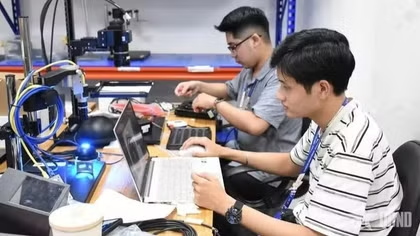
The project equips Vietnamese universities and research institutes with the knowledge and tools to capitalise on their research potential, empowering them to produce working prototypes, and in turn making innovative technologies more accessible to the economy – particularly to small and medium-sized enterprises (SMEs).
A key aim of the project is to demonstrate the UTS Rapido model of technology transfer through pilot activities that introduce new technologies to water systems in two different regions of Vietnam.
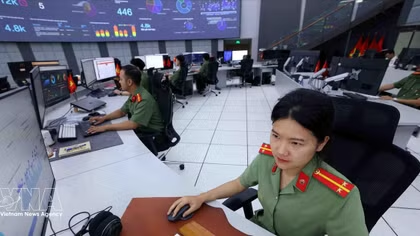
In Xuan Dai bay, the south-central province of Phu Yen, researchers from UTS and Ho Chi Minh University of Technology (HCMUT) have launched a seawater environment monitoring system that employs cutting edge technology in robotics, Internet of Things (IoT), data analytics and mechatronics. The first of its kind in Vietnam, it is among very few worldwide that can provide real-time offshore environmental measurements in hostile conditions that include saltwater corrosion and seasonal heavy tropical storms.
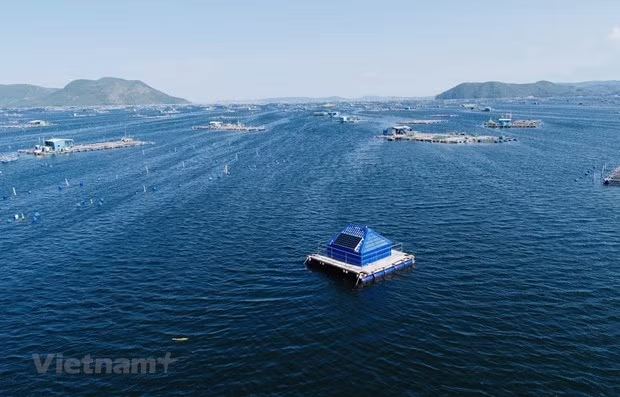 |
| High-tech sea water monitoring system in Phu Yen province. Photo: UTS Rapido Vietnam |
In the Hong (Red) River delta, improved designs for water filtration systems are increasing access to drinking water for households and communities, while UTS researchers and their local industry partners are working with Vietnam National University – University of Engineering and Technology (VNU-UET) to integrate sensing technology with the new systems.
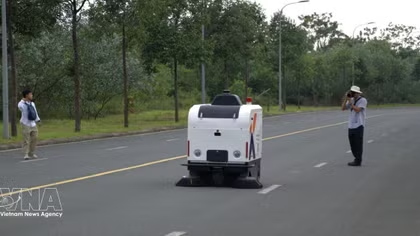
An automated treatment plant, currently under construction, will bring brand new technology to peri-urban Hanoi and build capacity in local industry, allowing them to manufacture similar systems and tap in to the manufacturing ability of Vietnam.
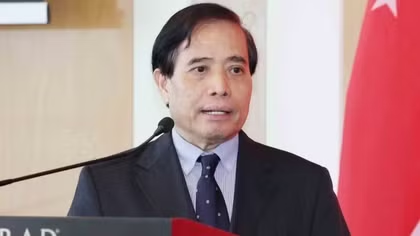
"The delivery of the seawater environment monitoring system and the water filtration systems during this uncertain time strongly proves UTS deep engagement with partners in Vietnam through our joint research centers with VNU-UET in Hanoi and HCMUT in Ho Chi Minh City. Addressing the internationally emerging challenges in ocean environment and in ground water pollution, the project again highlights the unique strength and impact of UTS practice-oriented research not only in Vietnam but globally," said Prof. Ian Burnett, Dean of the Faculty of Engineering and Information Technology, UTS.
COVID-19 was an entirely unforseen disruption to the project, as it was for the rest of the world.
Nonetheless, the nature of the project and its objectives have allowed it to navigate and even take advantage of restrictions and obstacles imposed by the pandemic, finding new ways to collaborate and engage with industry, and fostering independence in the pilot Rapido teams established in Vietnam.
Due to international travel bans, teams of researchers from UTS and partners VNU-UET and HCMUT have worked remotely to plan and implement project activities. Teams in Vietnam have also navigated local travel bans and restricted access to project sites, which are located at a distance from the university hubs in Hanoi and Ho Chi Minh City.
The impact of the pandemic has meant adapting to a ‘new normal’, where timelines and deliverables are reevaluated and, in some cases, reimagined – and there have been plenty of opportunities to innovate.
The team delivered a virtual technology transfer workshop early on, harnessing the opportunities presented by teleconferencing platforms and social media networks to extend the reach of the training beyond what was initially planned.
A new technology transfer unit, HCMUT Rapido, harnessed the research capabilities of HCMUT to develop an IoT-enabled ventilator at the height of the pandemic in Vietnam. This project, the first self-contained project under the new Rapido Vietnam model, demonstrated the agility and user-focus that are characteristic of the Rapido model.
The COVID-19 pandemic has produced disastrous economic and public heath outcomes globally. Yet in this case, it has enabled the growth of HCMUT Rapido, which grasped the opportunity to innovate and test their new capabilities.
HCMUT Rapido has gone on to deliver additional projects which address the impact of the virus, from online learning tools that demonstrate how Industry 4.0 technologies can help fight COVID-19, to an ATM which caters to people who are experiencing financial hardship due to the pandemic, while adhering to social distancing.
“The teams behind UTS Rapido Vietnam have effectively adjusted to COVID-19 restrictions and adapted to the new normal, embracing opportunities to find new ways of doing things in both Australia and Vietnam. This success in navigating the pandemic to deliver the aims of the project can be attributed to the deep working relationships between the Australian and Vietnamese partners, built over many years of close collaboration.” said Prof. Eryk Dutkiewicz, UTS Chief Investigator.
The strong and cooperative relationships that drive UTS Rapido Vietnam leave it exceptionally well-placed to deliver on its aims throughout the ongoing pandemic, as partners work closely to tailor the UTS Rapido model to Vietnam and establish a blueprint for technology transfer that can be applied to the entire country.
“By working closely with our partners in Vietnam, we are embedding an innovative technology development and transfer model to the country’s technology start-up ecosystem, starting from universities and R&D institutes,” said Dr. Diep N. Nguyen, UTS Co-Investigator.