Julian Assange is facing extradition to the United States and up to five years in prison after he was forcibly dragged from the Ecuadorian embassy in London on Thursday, bringing an extraordinary seven-year diplomatic stalemate to an end.
After 2,487 days in the embassy, the 47-year-old was arrested after Ecuador revoked his political asylum and invited Metropolitan police officers inside their Knightsbridge premises, where he has stayed since 2012 to avoid extradition to Sweden over sexual assault allegations which Assange has always denied.
Later on Thursday, he was found guilty of failing to surrender to the court and faces up to 12 months in a British prison.
At a central London police station, Assange was further arrested at the request of the US seeking his extradition over allegations he conspired with former US military analyst Chelsea Manning to download classified databases in what the US justice department called “one of the largest compromises of classified information in the history of the United States”.
The arrest provoked a fierce debate over Assange’s future and possible extradition. While the government defended the arrest over breaching bail as evidence that “no-one is above the law”, Labour and civil liberties groups condemned the US extradition request.
Assange’s lawyer, Jennifer Robinson, told the BBC’s Newsnight programme her client’s arrest set a “dangerous precedent” that should concern free speech advocates.
In the US, Donald Trump said “I know nothing about WikiLeaks,” adding, “it’s not my thing.” In the final month of the 2016 election, Trump mentioned WikiLeaks 164 times. His opponent in that election, Hillary Clinton, said the WikiLeaks founder needs to “answer for what he has done”
Assange, an Australian citizen, will receive consular assistance on Friday but won’t be given any “special treatment”, the country’s prime minister, Scott Morrison, said. The country’s defence minister, Marise Payne, said Assange’s potential extradition to the US was an issue between the UK and the US.
Labour’s Diane Abbott argued that it was Assange’s work to expose wrongdoing that had put him at risk of a US prison sentence, telling parliament: “It is whistleblowing activity into illegal wars, mass murder, murder of civilians and corruption on a grand scale that has put Julian Assange in the crosshairs.”
Freedom of speech advocates including US whistleblower Edward Snowden said that an extradition over the leaks constituted a risk to press freedom. Meanwhile, as others argued that the US charges should be considered separately to the Swedish allegations, prosecutors in Stockholm said that his arrest was “news to us”.
Events moved at pace as Assange later appeared at Westminster magistrates court to deny failing to surrender to court. Finding him guilty, district judge Michael Snow said his behaviour was “the behaviour of a narcissist who cannot get beyond his own selfish interest”. He faces up to 12 months in jail when sentenced, and will face a separate extradition hearing via videolink on 2 May.
The US accuses Assange of “conspiracy to commit computer intrusion”, alleging that he assisted Manning in cracking a password to help her infiltrate Pentagon computers and download material to share with WikiLeaks. If convicted, Assange faces a maximum sentence of five years .
Dramatic footage showed him handcuffed, heavily bearded and with his hair tied back, gesticulating and shouting “UK must resist” as plainclothes officers carried him from the embassy shortly after 10am to a waiting police van. He was clutching what appeared to be a copy of Gore Vidal’s History of the National Security State.
One Assange supporter, who witnessed the arrest, said: “There were at least six men dragging Julian out and more uniformed police standing by. Julian was talking but he was bundled into a van. He looked dazed.
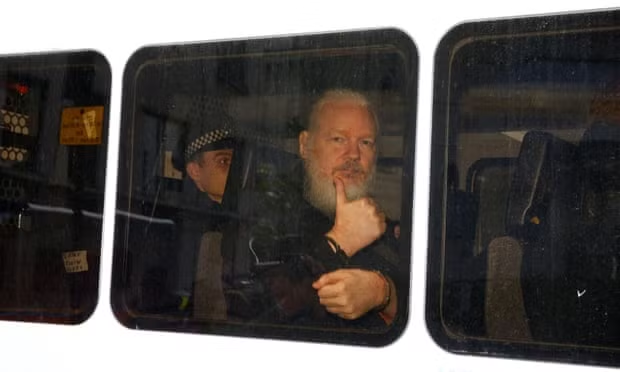 |
| Assange in a police van after he was arrested by British police. Photograph: Henry Nicholls/Reuters |
Westminster magistrates court heard that when police arrived inside the embassy, Assange barged past them in an attempt to return to his private room. He had to be restrained after resisting arrest and claiming “this is unlawful”.
Judge Michael Snow was highly scathing of Assange, saying “His behaviour is that of a narcissist who cannot get beyond his own selfish interests.”
Outside court,r Robinson said they had warned since 2010 that Assange would face extradition to the US. “Unfortunately, today we have been proved right.” She said Assange thanked his supporters, and had said: “I told you so.”
Assange was initially arrested for failing to surrender to the court after losing an appeal against extradition to Sweden, where he faced two separate 2010 sexual assault allegations.
Elisabeth Massi Fritz, lawyer for one of the two women accusers, said they would seek to get the Swedish police investigation re-opened “so that Assange can be extradited to Sweden and prosecuted for rape”. One of the women told the Guardian she would be “very surprised and sad” if Assange was extradited to the US. “For me this was never about anything else than his misconduct against me and other women,” she said.
Theresa May told MPs that she welcomed the arrest: “This goes to show that in the United Kingdom, no one is above the law.” Downing Street said the prime minister and the government were aware in advance that Ecuador intended to revoke Assange’s asylum status. A No 10 spokeswoman said while there had been “a dialogue with the Ecuadorian government from the start” the decision to revoke asylum “was one for them entirely”.
Explaining the decision, Ecuador’s president, Lenín Moreno, said: “In a sovereign decision Ecuador withdrew the asylum status to Julian Assange after his repeated violations to international conventions and daily-life protocols.” He accused Assange of interfering in the internal affairs of other countries, and added: ‘The patience of Ecuador has reached its limit.
The Ecuadorian ambassador to the UK, Jaime Marchan, said: “He was continually a problem to us, he was very disrespectful to the authorities, he has said that we were spying on him, he has said we were lying, we were agents of the United States.”
However, there was condemnation of the arrest from many quarters. Amnesty International UK said that if Sweden pursues extradition over sexual assault allegations, then assurances should be made over not sending Assange to the US. “There is a very real risk that he could face human rights violations” due to his work with WikiLeaks, a spokesperson said.
Ecuador’s former president, Rafael Correa, accused his successor of being the “greatest traitor in Ecuadorian and Latin American history”.
Snowden, the former US government contractor wanted for leaking details of US surveillance programmes, called the arrest a “dark moment for press freedom”. Meanwhile, actor Pamela Anderson, one of a diverse range of public figures and celebrities to have visited Assange, tweeted that she was “in shock”, and accused the UK of being “America’s bitch” and of seeking a diversion “from your idiotic Brexit bullshit”.
Manning downloaded four databases from US departments and agencies between January and May 2010, the indictment said, with the information provided to WikiLeaks. Some selected and edited material from WikiLeaks was published by the Guardian, the New York Times, Le Monde, El País and Der Speigel.
Assange’s arrest came one day after WikiLeaks accused the Ecuadorian government of an “extensive spying operation” against him, during which, it claimed, meeting with lawyers and a doctor inside the embassy over the past year were secretly filmed. Assange supporters reported increased police activity at the embassy last weekend.