Wikipedia is using Google Translate to make its articles available in more languages

Wikipedia’s goal is to make the world’s knowledge accessible to everyone on the planet, but it would be the first to admit that its efforts are skewed somewhat toward those who read English. To help fix this, the Wikimedia Foundation (which runs Wikipedia) announced today that it’s partnering with Google to take advantage of the company’s AI translation skills.

Google Translate will be integrated into Wikipedia’s in-house translation tool at no cost, added as an option alongside the open-source translator Apertium, which has been used to translate some 400,000 Wikipedia articles to date. In both cases, the software does the first pass of translating an article before a human editor steps in to correct any mistakes.
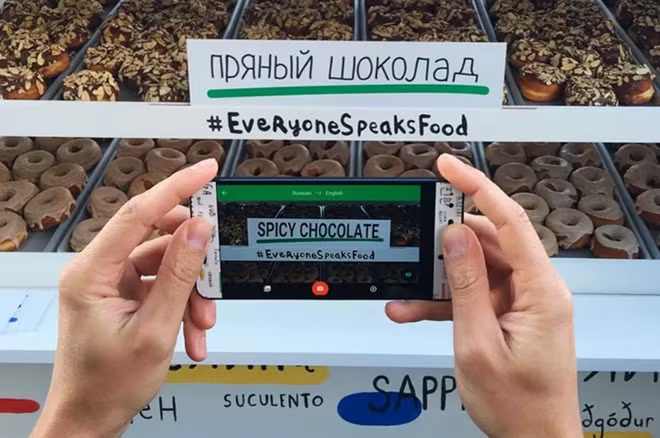
Photo: Google
Photo: Google

Wikipedia editors have been asking for access to extra translation tools like Google’s for a while. The ad company’s software is widely acknowledged as some of the world’s most advanced, thanks in no small part to Google’s AI prowess. And — as a more obvious benefit — it can handle 15 more languages than Apertium can.

These extra languages include Zulu, Hausa, Kurdish (Kurmanji), and Yoruba. These may not be the best-known languages on the world stage, but obviously, that doesn’t at all diminish their importance to those who speak them. Zulu, for example, is spoken by some 12 million people, but there are only around 1,000 Wikipedia articles available in the language.

In an FAQ, the Wikimedia Foundation has answered worries that some editors may have about the partnership, noting that no personal data is shared with Google, the translated content will still be freely available under a creative commons license (like all Wikipedia articles), and there will be no Google branding added to the site as a result of the deal. The agreement is only for a year, and it will be reevaluated after that, and the Wikimedia Foundation can terminate it at any time.

Importantly, all translations generated in this way will be freely available to the public. That means they can be used to improve other translation tools, including open-source software like Apertium. After all, if you want to make the world’s knowledge available freely to all, it’s a good idea to empower people to spread that knowledge themselves

The Verge

Other News

Vietnam targets at least 10 large strategic technology firms by 2030

Vietnam targets at least 10 large strategic technology firms by 2030

Deputy Prime Minister Ho Quoc Dung has signed a decision approving a plan to develop large domestic strategic technology enterprises in the 2026–2030 period, aimed at advancing digital infrastructure, digital human resources, digital data, strategic technologies and cybersecurity.

Protecting users crucial in building digital trust: Experts

Protecting users crucial in building digital trust: Experts

In Vietnam, digital transformation in the finance and banking sector is accelerating cashless payments, expanding access to financial services, improving market transparency and supporting economic growth and macroeconomic management.

Fostering skilled workforce for innovation era: experts

Fostering skilled workforce for innovation era: experts

Experts said close coordination among State management agencies, research institutes, universities, and businesses will improve training quality and serve the dual goals of quality education and practical research application.

Startup forum bridges Silicon Valley and local innovation ecosystem

Startup forum bridges Silicon Valley and local innovation ecosystem

The University of Economics Ho Chi Minh City (UEH), Saigon Asset Management (SAM), and Plug and Play Tech Centre co-hosted the “From Vietnam to Silicon Valley” forum, exploring AI innovation, venture capital, and pathways to integrate Vietnam’s startup ecosystem with Silicon Valley and global markets.

Experts call for stronger action against fake news online

Experts call for stronger action against fake news online

Experts have warned that fake news, misinformation and harmful online content are increasingly shaping public perceptions, particularly among young people, and stressed the need for stronger legal safeguards, technology tools and wider dissemination of credible information to tackle the problem effectively.

Protecting digital future in post-quantum, AI era

Protecting digital future in post-quantum, AI era

Participants highlighted the importance of building a proactive, synchronised and sustainable national cybersecurity ecosystem through closer cooperation among regulators, technology firms, research institutions and cybersecurity experts.

Vietnam attends SAHA 2026 defence, aerospace exhibition in Türkiye

Vietnam attends SAHA 2026 defence, aerospace exhibition in Türkiye

Vietnam’s participation in SAHA 2026 International Defence & Aerospace Exhibition in Istanbul reflects the country’s consistent policy of enhancing international defence integration and promoting defence industry cooperation towards self-reliance, self-strengthening, modernisation and dual-use development.

SK Group partners to build AI ecosystem in Vietnam

SK Group partners to build AI ecosystem in Vietnam

SK Innovation and SK Telecom signed MoUs with Nghe An province and the National Innovation Centre of Vietnam to advance AI ecosystem development and support the country’s long-term growth strategy.

Vietnam Research Excellence Fellowship for 2026-2030 approved

Vietnam Research Excellence Fellowship for 2026-2030 approved

Under the Vietnam Research Excellence Fellowship (VREF) for the 2026–2030 period, PhD students are identified as a core research force directly contributing to breakthroughs in sci-tech and innovation. Investing in top-tier doctoral candidates is more than workforce development, but a high-stakes strategic bet to forge a cohort of world-class scientists and technologists who can power Vietnam’s long-term economic ambitions.