Centre established to support semiconductor chip pilot production

The Ministry of Science and Technology has issued Decision No. 4386/QD-BKHCN defining the functions, tasks, powers and organisational structure of the national centre for support of semiconductor chip pilot production, a move expected to strengthen Vietnam’s position in the global semiconductor value chain.

The establishment of the centre, along with a clear delineation of its mandate, is seen as laying an important foundation for public service infrastructure to support chip design, pilot production and commercialisation. 

Under the decision, the centre operates under the Authority of ICT Industry and Communications (AITI) and is tasked with assisting the AITI Director in overseeing Vietnam’s semiconductor industry and supporting pilot chip production activities to drive sectoral growth. The centre is designed to address one of the key challenges facing chip design units in Vietnam, which is the lack of comprehensive support throughout the entire pilot production process. 

Specifically, the centre will provide essential infrastructure and public services to support semiconductor design and prototyping as part of Vietnam’s broader industrial strategy. Its services include support for pilot chip production; licensing access to electronic design automation (EDA) software; sharing intellectual property (IP) design libraries; technical design verification; training and testing; and other services related to semiconductor development in line with regulations. 
Centre established to support semiconductor chip pilot production -0
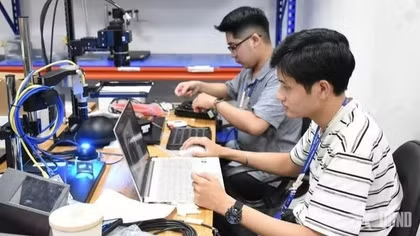
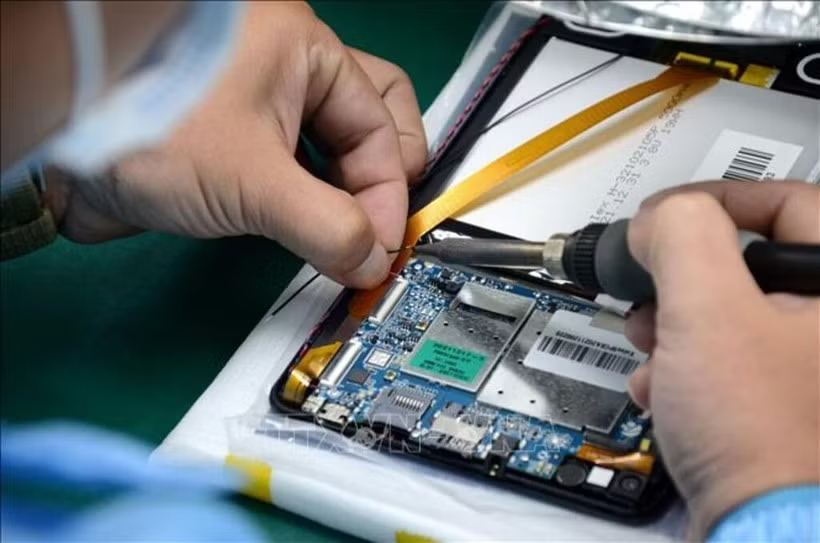
Vietnamese technology enterprises have already begun to make tangible progress in the semiconductor industry. (Photo: VNA)

Beyond technical support, the centre is expected to play a role in fostering a dynamic semiconductor ecosystem and promoting international cooperation, thereby nurturing innovation in the field. This aligns with the Government’s broader efforts to strengthen technological capabilities and deepen Vietnam’s integration into global supply chains. 

Human resources are identified as a critical pillar in Vietnam’s semiconductor development strategy, particularly as the country seeks to move beyond traditional segments such as assembly, packaging and testing into more advanced stages of the value chain. Vietnam currently has more than 7,000 skilled integrated circuit design engineers working across areas including packaging, testing, semiconductor materials and equipment. In 2025 alone, nearly 1,000 additional semiconductor design engineers were added, mainly through upskilling engineers from related fields. 

However, challenges remain in scaling up training programmes, expanding laboratory capacity and increasing the number of qualified lecturers and experts. Against this backdrop, workforce development has been identified as one of the centre’s core missions. 

The centre will organise intensive, practice-oriented training courses and assist universities in chip design activities, with a view to developing a highly skilled engineering workforce for this essential industry. The centre will also support start-ups and the commercialisation of semiconductor products by connecting them with investment funds and national funding programmes, while providing testing and performance evaluation services for chips after pilot production. 

Vietnamese technology enterprises have already begun to make tangible progress in the semiconductor sector. In late December, the FPT Group delivered its first batch of power management chips to a leading Japanese electronics company via Restar, one of Japan’s top electronic component distributors. This marked the first time a Vietnamese enterprise successfully introduced commercial chips into the Japanese market, known for its stringent quality and reliability requirements. 

The shipment represents a milestone for Vietnam’s chip design exports and demonstrates the potential of domestically developed intellectual property to reach wider markets across the Asia-Pacific region. 

It also underscores Vietnam’s image as an emerging destination on the global semiconductor map and opening new opportunities for deeper participation by local enterprises in high-tech global value chains.

VNA

Other News

Hanoi approves controlled pilot of two technology projects

Hanoi approves controlled pilot of two technology projects

The two projects involve an intelligent autonomous transportation system developed by Phenikaa-X JSC and a technology for producing mixed rare-earth oxides with a purity of over 95% on a semi-industrial scale developed by the Mining Technology and Construction Consultancy JSC.

Banking industry in AI era: When data becomes competitive advantage

Banking industry in AI era: When data becomes competitive advantage

In just a few years, AI has evolved from an experimental technology into an “assistant” for many banks, supporting everything from customer service, credit approval, and fraud detection to risk management. However, as the technological gap between institutions narrows, a new question is emerging: What will determine banks' competitive advantage in the AI era?

Bac Ninh considers establishing AI centre of excellence

Bac Ninh considers establishing AI centre of excellence

A meeting has been held in Bac Ninh to discuss potential cooperation with Plug and Play in developing the northern province’s innovation ecosystem and establishing an artificial intelligence (AI) centre of excellence, with Standing Vice Chairman of the provincial People’s Committee Mai Son receiving a delegation from the global innovation platform.

Hanoi allows 24-month trial of autonomous vehicles at Hoa Lac

Hanoi allows 24-month trial of autonomous vehicles at Hoa Lac

The project aims to assess the safety, reliability and readiness of autonomous vehicles under real traffic conditions, as well as the effectiveness of autonomous public transport and compatibility with existing systems. Its results will contribute to developing technical standards, operating procedures and management models suited to Hanoi’s traffic conditions.

Singapore's experience suggests solutions to Vietnam's human resources challenge in AI era

Singapore's experience suggests solutions to Vietnam's human resources challenge in AI era

As Vietnam accelerates digital transformation and high-tech development, Singapore’s experience and the engagement of global technology companies demonstrate that human resources preparation must stay ahead of the curve. The ability to filter knowledge, collaborate, innovate and effectively use AI will increasingly become essential to helping workers adapt to a changing labour market and strengthening the competitiveness of Vietnam’s economy in the new era.

Protecting national security amid digital transformation, cyberspace

Protecting national security amid digital transformation, cyberspace

Cybersecurity, information security and data security risks must be identified and addressed early and from afar, with appropriate defensive measures ready to neutralise threats and protect national interests in cyberspace, said Lieutenant General Le Xuan Minh, Director of the Ministry of Public Security’s Department of Cybersecurity and Hi-tech Crime Prevention (A05).

Mekong Delta launches first robotics, AI research institute

Mekong Delta launches first robotics, AI research institute

Dr. Nguyen Van Quang, Rector of Nam Can Tho University, said the university is developing a value chain covering training, research, technology development, testing, technology transfer and commercialisation. The model is designed to link research more closely with practical needs, ensuring that technologies generate products and products create value for society.

Vietnam positioned to harness AI wave, World Bank report says

Vietnam positioned to harness AI wave, World Bank report says

The WB report identifies Vietnam as one of the few economies outside the European Union (EU) to have adopted a comprehensive AI regulatory framework as early as 2025. Vietnam applies a risk-tiered approach similar to that of the EU AI Act, imposing different obligations depending on whether an AI system poses “unacceptable,” “high,” “low” or “minimal” risks. The approach is viewed as a strategic step towards ensuring safe and transparent AI governance.

AI offers both opportunities, challenges for Vietnam's growth

AI offers both opportunities, challenges for Vietnam's growth

Dr. Ho Duc Thang, a full-time member of the National Assembly’s Committee for Cultural and Educational, said productivity is the key to sustaining double-digit economic growth, and AI has greater potential to improve productivity than any previous technology.

Top leader unveils people-centred vision for new development model

Top leader unveils people-centred vision for new development model

Vietnam's growth model, long fueled by low-cost labour, resource extraction, contract manufacturing, expanded investment, and capital accumulation, has run out of road. The country now needs a sweeping reform agenda to shift from extensive growth to a model driven by productivity, knowledge, science and technology, innovation, and digital transformation.