Commercialising research results needs collaboration between gov’t, firms

The Government should have specific measures to enhance collaboration between academia and businesses so that more research can be converted into practical technology, heard a workshop in Ho Chi Minh City on July 20.

The event, in which many Vietnamese and foreign experts took part and had the theme ‘Commercialisation of scientific research results’, discussed experiences and models in commercialising research outcomes in the Republic of Korea, Germany and Australia.

Delegates also discussed the lacunae and barriers that make taking research work from the laboratory to businesses difficult.

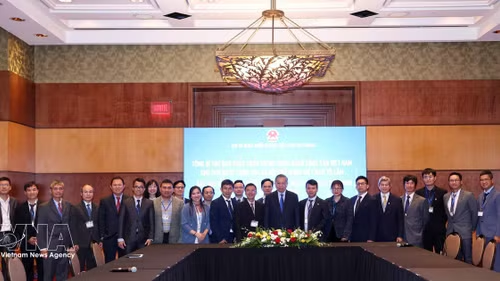
Delegates at a workshop titled ‘Commercialisation of scientific research results’ held in HCM City on July 20. (Photo: VNA)

Nguyen Minh Huyen Trang, Deputy Director of the Centre for Intellectual Property and Technology Transfer at the Vietnam National University in HCM City, said there was a big gap between universities and research institutes on one hand and enterprises on the other.

"When the former want to develop the market for their technologies or find partners to commercialise their scientific research, they come up against policy-related hurdles," she said, adding overlapping and complicated procedures greatly discouraged scientists.

The Government has policies to support businesses and scientists that carry on research, but there are no tools to foster links between scientists and businesses, according to delegates.

Ninety percent of enterprises in HCM City are micro or small-sized and lack the financial and human resources for R&D.

Meanwhile, businesses focus on short-term commercial goals instead of long-term investment in technology and research.

The country should learn from others such as the Republic of Korea and Germany to provide practical support policies to shrink the gap between academia and businesses, delegates said.

A large number of Vietnamese researchers studied in South Korea and now worked in almost all industries in HCM City, some experts said.

The city should have a model for effective collaboration with that country, and the establishment of a joint business promotion centre with the participation of universities was needed to accelerate this and focus on support policies for research and development at universities and commercialising research results, they added.

The workshop organised by the Saigon Innovation Hub belonging to the Department of Science and Technology was also attended by representatives of universities, research institutes and businesses in the city./


VNA

Other News

AI offers both opportunities, challenges for Vietnam's growth

AI offers both opportunities, challenges for Vietnam's growth

Dr. Ho Duc Thang, a full-time member of the National Assembly’s Committee for Cultural and Educational, said productivity is the key to sustaining double-digit economic growth, and AI has greater potential to improve productivity than any previous technology.

Top leader unveils people-centred vision for new development model

Top leader unveils people-centred vision for new development model

Vietnam's growth model, long fueled by low-cost labour, resource extraction, contract manufacturing, expanded investment, and capital accumulation, has run out of road. The country now needs a sweeping reform agenda to shift from extensive growth to a model driven by productivity, knowledge, science and technology, innovation, and digital transformation.

First national semiconductor chip prototyping support centre makes debut

First national semiconductor chip prototyping support centre makes debut

Vietnam's semiconductor ecosystem now comprises around 60 chip design companies, some 7,000 chip design engineers and 166 universities offering semiconductor-related training programmes. Initial registrations from 12 organisations indicate demand for the prototyping of approximately 30,000 chips.

Vietnam targets at least 10 large strategic technology firms by 2030

Vietnam targets at least 10 large strategic technology firms by 2030

Deputy Prime Minister Ho Quoc Dung has signed a decision approving a plan to develop large domestic strategic technology enterprises in the 2026–2030 period, aimed at advancing digital infrastructure, digital human resources, digital data, strategic technologies and cybersecurity.

Protecting users crucial in building digital trust: Experts

Protecting users crucial in building digital trust: Experts

In Vietnam, digital transformation in the finance and banking sector is accelerating cashless payments, expanding access to financial services, improving market transparency and supporting economic growth and macroeconomic management.

Fostering skilled workforce for innovation era: experts

Fostering skilled workforce for innovation era: experts

Experts said close coordination among State management agencies, research institutes, universities, and businesses will improve training quality and serve the dual goals of quality education and practical research application.

Startup forum bridges Silicon Valley and local innovation ecosystem

Startup forum bridges Silicon Valley and local innovation ecosystem

The University of Economics Ho Chi Minh City (UEH), Saigon Asset Management (SAM), and Plug and Play Tech Centre co-hosted the “From Vietnam to Silicon Valley” forum, exploring AI innovation, venture capital, and pathways to integrate Vietnam’s startup ecosystem with Silicon Valley and global markets.

Experts call for stronger action against fake news online

Experts call for stronger action against fake news online

Experts have warned that fake news, misinformation and harmful online content are increasingly shaping public perceptions, particularly among young people, and stressed the need for stronger legal safeguards, technology tools and wider dissemination of credible information to tackle the problem effectively.

Protecting digital future in post-quantum, AI era

Protecting digital future in post-quantum, AI era

Participants highlighted the importance of building a proactive, synchronised and sustainable national cybersecurity ecosystem through closer cooperation among regulators, technology firms, research institutions and cybersecurity experts.