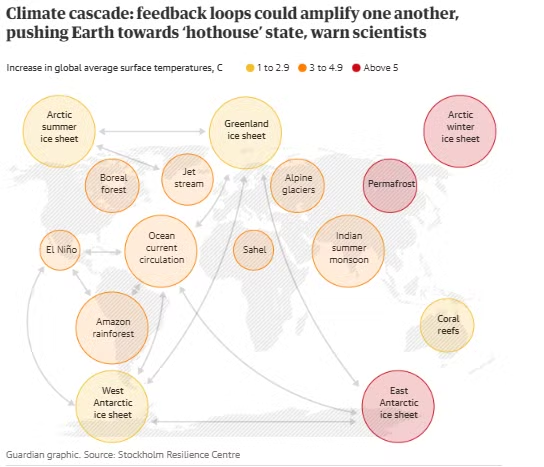
This grim prospect is sketched out in a journal paper that considers the combined consequences of 10 climate change processes, including the release of methane trapped in Siberian permafrost and the impact of melting ice in Greenland on the Antarctic.
The authors of the essay, published in Proceedings of the National Academy of Sciences, stress their analysis is not conclusive, but warn the Paris commitment to keep warming at 2C above pre-industrial levels may not be enough to “park” the planet’s climate at a stable temperature.
They warn that the hothouse trajectory “would almost certainly flood deltaic environments, increase the risk of damage from coastal storms, and eliminate coral reefs (and all of the benefits that they provide for societies) by the end of this century or earlier.”
 |
“I do hope we are wrong, but as scientists we have a responsibility to explore whether this is real,” said Johan Rockström, executive director of the Stockholm Resilience Centre. “We need to know now. It’s so urgent. This is one of the most existential questions in science.”
Rockström and his co-authors are among the world’s leading authorities on positive feedback loops, by which warming temperatures release new sources of greenhouse gases or destroy the Earth’s ability to absorb carbon or reflect heat.
Their new paper asks whether the planet’s temperature can stabilise at 2C or whether it will gravitate towards a more extreme state. The authors attempt to assess whether warming can be halted or whether it will tip towards a “hothouse” world that is 4C warmer than pre-industrial times and far less supportive of human life.
Katherine Richardson from the University of Copenhagen, one of the authors, said the paper showed that climate action was not just a case of turning the knob on emissions, but of understanding how various factors interact at a global level.
“We note that the Earth has never in its history had a quasi-stable state that is around 2C warmer than the preindustrial and suggest that there is substantial risk that the system, itself, will ‘want’ to continue warming because of all of these other processes – even if we stop emissions,” she said. “This implies not only reducing emissions but much more.”
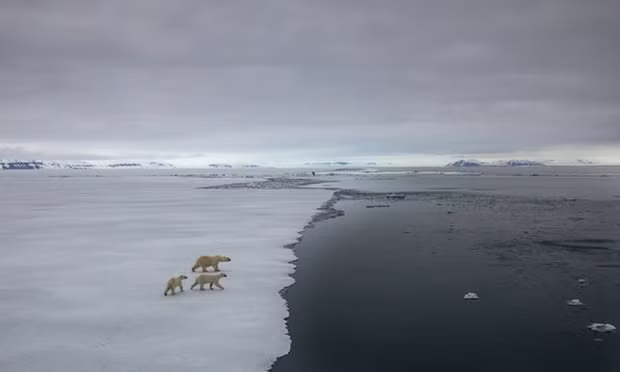 |
| Polar bears on sea ice: the loss of the Greenland ice sheet could disrupt the Gulf Stream, which would in turn raise sea levels and accelerate Antarctic ice loss. Photograph: Paul Goldstein/Cover Images |
New feedback loops are still being discovered. A separate paper published in PNAS reveals that increased rainfall – a symptom of climate change in some regions - is making it harder for forest soils to trap greenhouse gases such as methane.
Previous studies have shown that weakening carbon sinks will add 0.25C, forest dieback will add 0.11C, permafrost thaw will add 0.9C and increased bacterial respiration will add 0.02C. The authors of the new paper also look at the loss of methane hydrates from the ocean floor and the reduction of snow and ice cover at the poles.
Rockström says there are huge gaps in data and knowledge about how one process might amplify another. Contrary to the Gaia theory, which suggests the Earth has a self-righting tendency, he says the feedbacks could push the planet to a more extreme state.
As an example, the authors say the loss of Greenland ice could disrupt the Gulf Stream ocean current, which would raise sea levels and accumulate heat in the Southern Ocean, which would in turn accelerate ice loss from the east Antarctic. Concerns about this possibility were heightened earlier this year by reports that the Gulf Stream was at its weakest level in 1,600 years.
Currently, global average temperatures are just over 1C above pre-industrial levels and rising at 0.17C per decade. The Paris climate agreement set actions to keep warming limited to 1.5C-2C by the end of the century, but the authors warn more drastic action may be necessary.
“The heatwave we now have in Europe is not something that was expected with just 1C of warming,” Rockström said. “Several positive feedback loops are already in operation, but they are still weak. We need studies to show when they might cause a runaway effect.
Another climate scientist – who was not involved in the paper – emphasised the document aimed to raise questions rather than prove a theory. “It’s rather selective, but not outlandish,” said Prof Martin Siegert, co-director of the Grantham Institute. “Threshold and tipping points have been discussed previously, but to state that 2C is a threshold we can’t pull back from is new, I think. I’m not sure what ‘evidence’ there is for this – or indeed whether there can be until we experience it.”
Rockström said the question needed asking. “We could end up delivering the Paris agreement and keep to 2C of warming, but then face an ugly surprise if the system starts to slip away,” he said. “We don’t say this will definitely happen. We just list all the disruptive events and come up with plausible occurrences … 50 years ago, this would be dismissed as alarmist, but now scientists have become really worried.”
“In the context of the summer of 2018, this is definitely not a case of crying wolf, raising a false alarm: the wolves are now in sight,” said Dr Phil Williamson, a climate researcher at the University of East Anglia. “The authors argue that we need to be much more proactive in that regard, not just ending greenhouse gas emissions as rapidly as possible, but also building resilience in the context of complex Earth system processes that we might not fully understand until it is too late.”