Facebook will start warning users who engaged with 'harmful' misinformation

Facebook will begin showing notifications to users who have interacted with posts that contain “harmful” coronavirus misinformation, the company announced on Thursday, in an aggressive new move to address the spread of false information about Covid-19.

The new policy applies only to misinformation that Facebook considers likely to contribute to “imminent physical harm”, such as false claims about “cures” or statements that physical distancing is not effective. Facebook’s policy has been to remove those posts from the platform.

Under the new policy, which will be rolled out in the coming weeks, users who liked, shared, commented or reacted with an emoji to such posts before they were deleted will see a message in their news feed directing them to a “myth busters” page maintained by the World Health Organization (WHO).

“We want to connect people who may have interacted with harmful misinformation about the virus with the truth from authoritative sources in case they see or hear these claims again off of Facebook,” said Guy Rosen, Facebook’s vice-president of integrity, in a blogpost.
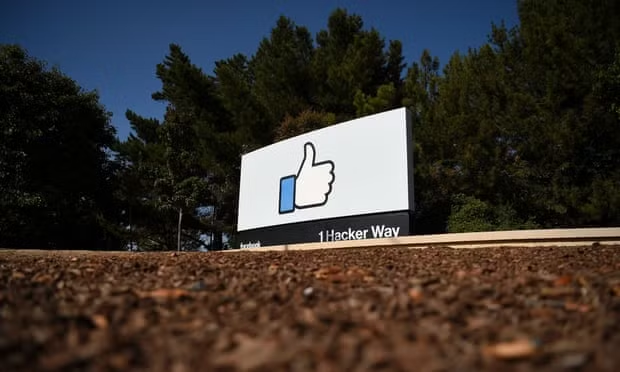
The new policy only applies to misinformation Facebook believes is likely to contribute to ‘imminent physical harm’. Photograph: Josh Edelson
 The new policy only applies to misinformation Facebook believes is likely to contribute to ‘imminent physical harm’. Photograph: Josh Edelson

Facebook does not take down other misinformation about Covid-19, such as conspiracy theories about the virus’s origins, but instead relies on its third-party factchecking system. If a factchecker rates a claim false, Facebook then adds a notice to the post, reduces its spread, alerts anyone who shared it, and discourages users from sharing it further.

The announcement coincides with the release of a new report by the online activist group Avaaz that highlights Facebook’s shortcomings in counteracting the coronavirus “infodemic”. The study found examples of coronavirus misinformation remaining on the platform even after third-party fact checks had been completed. Avaaz also cited delays in Facebook applying factchecking labels to posts.

Facebook challenged the methodology of Avaaz’s report but said it “appreciated their partnership in developing the notifications we’ll now be showing people”.

Avaaz celebrated Facebook’s decision to show notifications to users exposed to misinformation.

“We’ve been calling on Facebook to take this step for three years now,” said Fadi Quran, Avaaz’s campaign director. “It’s a courageous step by Facebook. At the same time, it’s not enough.”

The group wants Facebook’s notifications to be more explicit about the misinformation that the user was exposed to, and it wants the notification shown to any user who saw the misinformation in their news feed, regardless of whether they interacted with the post.

“We think that correcting the record retroactively … will make people more resilient to misinformation in the future, and it will disincentivize malicious users,” said Quran.

But Facebook cited concerns that more explicit messages could do more harm than good.

Misinformation researchers at First Draft News, for example, have long counseled that repeating a false claim, even to debunk it, can help to reinforce it in a person’s mind.

Claire Wardle, the US director of First Draft News, said that she generally shared Facebook’s concern that repeating the misinformation in a notification could have a negative effect. Wardle usually advises debunkers of misinformation to “lead with the fact”, but she noted that such a rule is difficult to follow in relation to the pandemic, where scientific understanding of the virus is continuously evolving.

Wardle welcomed the move by Facebook as a signal that the company was trying to be “innovative” and “braver”, while warning that there could be “unintended consequences”. Among the potential pitfalls she flagged is the fact that people in different countries have different levels of trust in the WHO.

“I like this and want to support it, but also want to recognize that we know so little that this could go horribly wrong,” she said. “What I hope is that they are testing this with some independent academics.

The Guardian

Other News

Vietnam targets at least 10 large strategic technology firms by 2030

Vietnam targets at least 10 large strategic technology firms by 2030

Deputy Prime Minister Ho Quoc Dung has signed a decision approving a plan to develop large domestic strategic technology enterprises in the 2026–2030 period, aimed at advancing digital infrastructure, digital human resources, digital data, strategic technologies and cybersecurity.

Protecting users crucial in building digital trust: Experts

Protecting users crucial in building digital trust: Experts

In Vietnam, digital transformation in the finance and banking sector is accelerating cashless payments, expanding access to financial services, improving market transparency and supporting economic growth and macroeconomic management.

Fostering skilled workforce for innovation era: experts

Fostering skilled workforce for innovation era: experts

Experts said close coordination among State management agencies, research institutes, universities, and businesses will improve training quality and serve the dual goals of quality education and practical research application.

Startup forum bridges Silicon Valley and local innovation ecosystem

Startup forum bridges Silicon Valley and local innovation ecosystem

The University of Economics Ho Chi Minh City (UEH), Saigon Asset Management (SAM), and Plug and Play Tech Centre co-hosted the “From Vietnam to Silicon Valley” forum, exploring AI innovation, venture capital, and pathways to integrate Vietnam’s startup ecosystem with Silicon Valley and global markets.

Experts call for stronger action against fake news online

Experts call for stronger action against fake news online

Experts have warned that fake news, misinformation and harmful online content are increasingly shaping public perceptions, particularly among young people, and stressed the need for stronger legal safeguards, technology tools and wider dissemination of credible information to tackle the problem effectively.

Protecting digital future in post-quantum, AI era

Protecting digital future in post-quantum, AI era

Participants highlighted the importance of building a proactive, synchronised and sustainable national cybersecurity ecosystem through closer cooperation among regulators, technology firms, research institutions and cybersecurity experts.

Vietnam attends SAHA 2026 defence, aerospace exhibition in Türkiye

Vietnam attends SAHA 2026 defence, aerospace exhibition in Türkiye

Vietnam’s participation in SAHA 2026 International Defence & Aerospace Exhibition in Istanbul reflects the country’s consistent policy of enhancing international defence integration and promoting defence industry cooperation towards self-reliance, self-strengthening, modernisation and dual-use development.

SK Group partners to build AI ecosystem in Vietnam

SK Group partners to build AI ecosystem in Vietnam

SK Innovation and SK Telecom signed MoUs with Nghe An province and the National Innovation Centre of Vietnam to advance AI ecosystem development and support the country’s long-term growth strategy.

Vietnam Research Excellence Fellowship for 2026-2030 approved

Vietnam Research Excellence Fellowship for 2026-2030 approved

Under the Vietnam Research Excellence Fellowship (VREF) for the 2026–2030 period, PhD students are identified as a core research force directly contributing to breakthroughs in sci-tech and innovation. Investing in top-tier doctoral candidates is more than workforce development, but a high-stakes strategic bet to forge a cohort of world-class scientists and technologists who can power Vietnam’s long-term economic ambitions.