Facebook's Oculus reveals stand-alone virtual reality headset

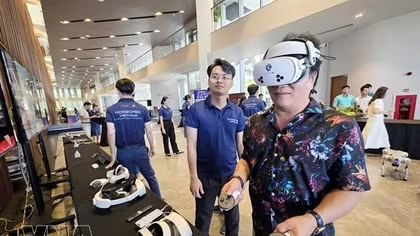
Facebook has unveiled a stand-alone virtual reality headset designed to extend the appeal of the company’s Oculus technology to the masses.

The headset, called Oculus Go, won’t require plugging in a smartphone or a cord tethering it to a personal computer like Oculus Rift or its competitor HTC’s Vive do.

“This all-in-one device makes VR more accessible than ever and represents a huge leap forward in comfort, visual clarity, and ease-of-use,” added Oculus in a blogpost.

The headset is lightweight and features a high-resolution LCD screen and speakers built in to deliver “spatial audio”.

When it hits the market next year it will cost $199, which is a big drop from the Rift, which originally sold for $599 and required a powerful computer costing at least $500 to power the virtual reality experiences and games. Recent discounts lowered the Rift’s price to $399 at various times during the summer, a markdown Oculus now says will be permanent.

The Gear competes against other headsets, such as Google’s $99 Daydream View, that require a smartphone. Google is also working on a stand-alone headset that won’t require a phone, but the company hasn’t specified when that device will be released or how much it will cost.

Zuckerberg promised the Oculus Go would be “the most accessible VR experience ever” and help realize his new goal of having 1 billion people dwelling in virtual reality at some point in the future.

“One of the most powerful features of VR is empathy. My goal here was to show how VR can raise awareness and help us see what’s happening in different parts of the world,” he said, adding that he intended to publicize a partnership with the Red Cross where Facebook helps create population maps that can be used by rescue workers.

Facebook and other major technology companies such as Google and Microsoft that are betting on VR have a long way to go.

About 16 million head-mounted display devices were shipped in 2016, a number expected to rise to 22 million this year, according to Gartner. Those figures include headsets for what is known as augmented reality.

Zuckerberg, though, remains convinced that VR will evolve into a technology that reshapes the way people interact and experience life, much as Facebook’s social networks and smartphones already have. His visions carry weight, largely because Facebook now has more than 2 billion users and plays an influential role in how people communicate.

But VR so far has been embraced mostly by video game lovers, despite Facebook’s efforts to bring the technology into the mainstream since buying Oculus for $2bn three years ago.

Facebook has shaken up the Oculus management team since then in a series of moves that included the departure of its founder, Palmer Luckey, earlier this year.

The former Google executive Hugo Barra now oversees Facebook’s VR operations.

The Guardian

Other News

Hanoi approves controlled pilot of two technology projects

Hanoi approves controlled pilot of two technology projects

The two projects involve an intelligent autonomous transportation system developed by Phenikaa-X JSC and a technology for producing mixed rare-earth oxides with a purity of over 95% on a semi-industrial scale developed by the Mining Technology and Construction Consultancy JSC.

Banking industry in AI era: When data becomes competitive advantage

Banking industry in AI era: When data becomes competitive advantage

In just a few years, AI has evolved from an experimental technology into an “assistant” for many banks, supporting everything from customer service, credit approval, and fraud detection to risk management. However, as the technological gap between institutions narrows, a new question is emerging: What will determine banks' competitive advantage in the AI era?

Bac Ninh considers establishing AI centre of excellence

Bac Ninh considers establishing AI centre of excellence

A meeting has been held in Bac Ninh to discuss potential cooperation with Plug and Play in developing the northern province’s innovation ecosystem and establishing an artificial intelligence (AI) centre of excellence, with Standing Vice Chairman of the provincial People’s Committee Mai Son receiving a delegation from the global innovation platform.

Hanoi allows 24-month trial of autonomous vehicles at Hoa Lac

Hanoi allows 24-month trial of autonomous vehicles at Hoa Lac

The project aims to assess the safety, reliability and readiness of autonomous vehicles under real traffic conditions, as well as the effectiveness of autonomous public transport and compatibility with existing systems. Its results will contribute to developing technical standards, operating procedures and management models suited to Hanoi’s traffic conditions.

Singapore's experience suggests solutions to Vietnam's human resources challenge in AI era

Singapore's experience suggests solutions to Vietnam's human resources challenge in AI era

As Vietnam accelerates digital transformation and high-tech development, Singapore’s experience and the engagement of global technology companies demonstrate that human resources preparation must stay ahead of the curve. The ability to filter knowledge, collaborate, innovate and effectively use AI will increasingly become essential to helping workers adapt to a changing labour market and strengthening the competitiveness of Vietnam’s economy in the new era.

Protecting national security amid digital transformation, cyberspace

Protecting national security amid digital transformation, cyberspace

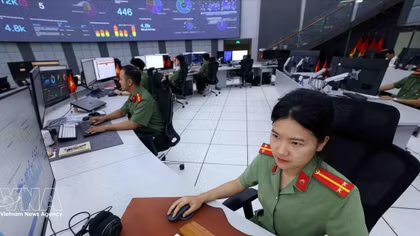
Cybersecurity, information security and data security risks must be identified and addressed early and from afar, with appropriate defensive measures ready to neutralise threats and protect national interests in cyberspace, said Lieutenant General Le Xuan Minh, Director of the Ministry of Public Security’s Department of Cybersecurity and Hi-tech Crime Prevention (A05).

Mekong Delta launches first robotics, AI research institute

Mekong Delta launches first robotics, AI research institute

Dr. Nguyen Van Quang, Rector of Nam Can Tho University, said the university is developing a value chain covering training, research, technology development, testing, technology transfer and commercialisation. The model is designed to link research more closely with practical needs, ensuring that technologies generate products and products create value for society.

Vietnam positioned to harness AI wave, World Bank report says

Vietnam positioned to harness AI wave, World Bank report says

The WB report identifies Vietnam as one of the few economies outside the European Union (EU) to have adopted a comprehensive AI regulatory framework as early as 2025. Vietnam applies a risk-tiered approach similar to that of the EU AI Act, imposing different obligations depending on whether an AI system poses “unacceptable,” “high,” “low” or “minimal” risks. The approach is viewed as a strategic step towards ensuring safe and transparent AI governance.

AI offers both opportunities, challenges for Vietnam's growth

AI offers both opportunities, challenges for Vietnam's growth

Dr. Ho Duc Thang, a full-time member of the National Assembly’s Committee for Cultural and Educational, said productivity is the key to sustaining double-digit economic growth, and AI has greater potential to improve productivity than any previous technology.

Top leader unveils people-centred vision for new development model

Top leader unveils people-centred vision for new development model

Vietnam's growth model, long fueled by low-cost labour, resource extraction, contract manufacturing, expanded investment, and capital accumulation, has run out of road. The country now needs a sweeping reform agenda to shift from extensive growth to a model driven by productivity, knowledge, science and technology, innovation, and digital transformation.