Facebook's solar-powered drone under investigation after 'accident'

Social network’s plan to bring 1 billion people online suffers blow as American National Transportation Safety Board examines ‘structural failure’ of Aquila drone.

Facebook has hit a hitch in its plans to use a solar-powered unmanned drone to provide internet access to developing nations, after it was revealed the American National Transportation Safety Board (NTSB) has opened an investigation into an accident on the drone’s first test flight in June.

At the time, Facebook described the flight as 'sccessful': the drone, called Aquila, stayed aloft for 96 minutes, three times the planned duration. “We have a lot of work ahead of us,” Jay Parikh, Facebook’s head of engineering and infrastructure, wrote when Facebook revealed the test flight, in late July. “In our next tests, we will fly Aquila faster, higher and longer, eventually taking it above 60,000 feet.”
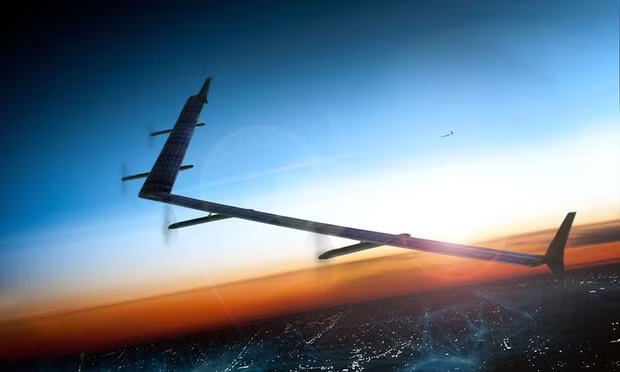
Facebook’s Aquila drone was developed in Bridgwater, Somerset, by a team Facebook acquired for $20m back in 2014. Photo: Facebook

In a second, more technical, blogpost published that same day, Facebook’s Martin Luis Gomez and Andrew Cox acknowledged the failure in passing. “Our first flight lasted three times longer than the minimum mission length, so we were able to gather data on how the structure and autopilot responded under a range of real-world conditions to help verify these predictions,” they wrote.

“We are still analysing the results of the extended test, including a structural failure we experienced just before landing. We hope to share more details on this and other structural tests in the future,” Cox and Gomez added.

It has now come to light that the “structural failure” led to an NTSB investigation, according to a report seen by Bloomberg News. The failure was classified by the NTSB as an “accident”, which requires “substantial” damage.
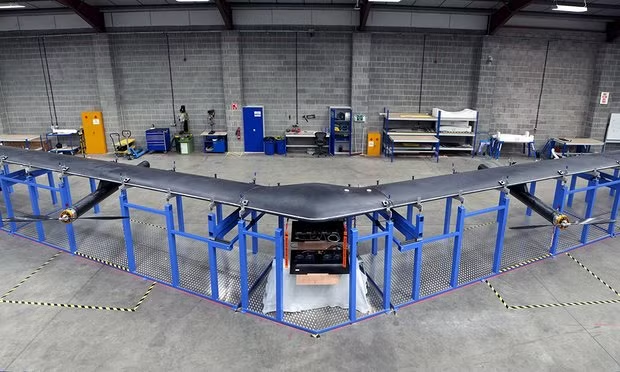
Facebook drone Aquila is a drone with a 130-ft (40-m) wingspan built by social media company Facebook, is shown in this publicity photo released to Reuters on July 30, 2015. Photo: HANDOUT/REUTERS

The drone is intended to boost Facebook's Internet.org project to bring a billion people online, by flying at a higher altitude than commercial planes and beaming data down to earth using lasers. The goal is for the plane to occupy a similar niche to satellites in providing access to remote areas, without the exorbitant launch costs that come with space-based communications technology.

The drone is physically little more than a lightweight wing with solar panels on the top, ensuring it can fly for extended periods of time without landing.

Aquila was developed in Bridgwater, Somerset, by a team Facebook aquired for $20m back in 2014. Formerly a consultancy called Ascenta, the team is led by 51-year old engineer Andrew Cox.
The Guardian

Other News

AI offers both opportunities, challenges for Vietnam's growth

AI offers both opportunities, challenges for Vietnam's growth

Dr. Ho Duc Thang, a full-time member of the National Assembly’s Committee for Cultural and Educational, said productivity is the key to sustaining double-digit economic growth, and AI has greater potential to improve productivity than any previous technology.

Top leader unveils people-centred vision for new development model

Top leader unveils people-centred vision for new development model

Vietnam's growth model, long fueled by low-cost labour, resource extraction, contract manufacturing, expanded investment, and capital accumulation, has run out of road. The country now needs a sweeping reform agenda to shift from extensive growth to a model driven by productivity, knowledge, science and technology, innovation, and digital transformation.

First national semiconductor chip prototyping support centre makes debut

First national semiconductor chip prototyping support centre makes debut

Vietnam's semiconductor ecosystem now comprises around 60 chip design companies, some 7,000 chip design engineers and 166 universities offering semiconductor-related training programmes. Initial registrations from 12 organisations indicate demand for the prototyping of approximately 30,000 chips.

Vietnam targets at least 10 large strategic technology firms by 2030

Vietnam targets at least 10 large strategic technology firms by 2030

Deputy Prime Minister Ho Quoc Dung has signed a decision approving a plan to develop large domestic strategic technology enterprises in the 2026–2030 period, aimed at advancing digital infrastructure, digital human resources, digital data, strategic technologies and cybersecurity.

Protecting users crucial in building digital trust: Experts

Protecting users crucial in building digital trust: Experts

In Vietnam, digital transformation in the finance and banking sector is accelerating cashless payments, expanding access to financial services, improving market transparency and supporting economic growth and macroeconomic management.

Fostering skilled workforce for innovation era: experts

Fostering skilled workforce for innovation era: experts

Experts said close coordination among State management agencies, research institutes, universities, and businesses will improve training quality and serve the dual goals of quality education and practical research application.

Startup forum bridges Silicon Valley and local innovation ecosystem

Startup forum bridges Silicon Valley and local innovation ecosystem

The University of Economics Ho Chi Minh City (UEH), Saigon Asset Management (SAM), and Plug and Play Tech Centre co-hosted the “From Vietnam to Silicon Valley” forum, exploring AI innovation, venture capital, and pathways to integrate Vietnam’s startup ecosystem with Silicon Valley and global markets.