Google to shut down Google+ after failing to disclose user data leak

This March, as Facebook was coming under global scrutiny over the harvesting of personal data for Cambridge Analytica, Google discovered a skeleton in its own closet: a bug in the API for Google+ had been allowing third-party app developers to access the data not just of users who had granted permission, but of their friends.

If that sounds familiar, it’s because it’s almost exactly the scenario that got Mark Zuckerberg dragged in front of the US Congress. The parallel was not lost on Google, and the company chose not to disclose the data leak, the Wall Street Journal revealed Monday, in order to avoid the public relations headache and potential regulatory enforcement.

Disclosure will likely result “in us coming into the spotlight alongside or even instead of Facebook despite having stayed under the radar throughout the Cambridge Analytica scandal”, Google policy and legal officials wrote in a memo obtained by the Journal. It “almost guarantees Sundar will testify before Congress”, the memo said, referring to the company’s CEO, Sundar Pichai. The disclosure would also invite “immediate regulatory interest”.

Shortly after the story was published, Google announced that it will shut down consumer access to Google+ and improve privacy protections for third-party applications.
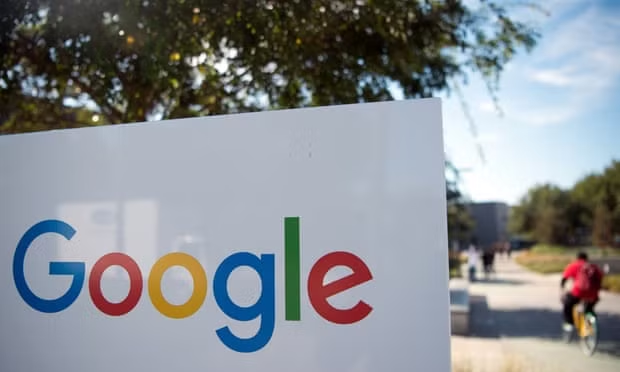
Google announced it is shutting down the consumer version of its online social network after fixing a bug exposing private data in as many as 500,000 accounts. Photograph: Josh Edelson
 Google announced it is shutting down the consumer version of its online social network after fixing a bug exposing private data in as many as 500,000 accounts. Photograph: Josh Edelson

In a blog post about the shutdown, Google disclosed the data leak, which it said potentially affected up to 500,000 accounts. Up to 438 different third-party applications may have had access to private information due to the bug, but Google apparently has no way of knowing whether they did because it only maintains logs of API use for two weeks.

“We found no evidence that any developer was aware of this bug, or abusing the API, and we found no evidence that any profile data was misused,” Ben Smith, the vice-president of engineering, wrote in the blogpost.

Smith defended the decision not to disclose the leak, writing: “Whenever user data may have been affected, we go beyond our legal requirements and apply several criteria focused on our users in determining whether to provide notice.”

None of the thresholds for public disclosure were met, Smith said. 

There is no federal law that obliges Google to disclose data leaks, but there are laws at a state level. In California, where Google is headquartered, companies are only required to disclose a data leak if it includes both an individual’s name and their Social Security number, ID card or driver’s license number, license plate, medical information or health insurance information.

Google also announced a series of reforms to its privacy policies designed to give users more control on the amount of data they share with third-party app developers.

Users will now be able to have more “fine grained” control over the various aspects of their Google accounts that they grant to third-parties (ie calendar entries v Gmail), and Google will further limit third-parties’ access to email, SMS, contacts and phone logs.

David Carroll is a US professor who sued Cambridge Analytica earlier this year to find out what data the company had stored about him. He said that given the legal issues Facebook faces over its Cambridge Analytica cover-up, it’s not surprising Google tried to keep the leak out of the public eye.

“Google is right to be concerned and the shutdown of Google+ shows how disposable things really are in the face of accountability,” he said.

For others, the leak was further evidence that the large technology platforms need more regulatory oversight.

“Monopolistic internet platforms like Google and Facebook are probably ‘too big to secure’ and are certainly ‘too big to trust’ blindly,” said Jeff Hauser, from the Centre for Economic and Policy Research.

He argued that the US Federal Trade Commission should move toward “breaking these platforms up”.

“In the interim, since we cannot trust that we know much or even most of what ought to concern the public, the FTC should install public-minded privacy monitors into the firms as an element of accountability.”
The Guardian

Other News

SK Group partners to build AI ecosystem in Vietnam

SK Group partners to build AI ecosystem in Vietnam

SK Innovation and SK Telecom signed MoUs with Nghe An province and the National Innovation Centre of Vietnam to advance AI ecosystem development and support the country’s long-term growth strategy.

Vietnam Research Excellence Fellowship for 2026-2030 approved

Vietnam Research Excellence Fellowship for 2026-2030 approved

Under the Vietnam Research Excellence Fellowship (VREF) for the 2026–2030 period, PhD students are identified as a core research force directly contributing to breakthroughs in sci-tech and innovation. Investing in top-tier doctoral candidates is more than workforce development, but a high-stakes strategic bet to forge a cohort of world-class scientists and technologists who can power Vietnam’s long-term economic ambitions.

Strategic tech must address practical challenges: PM

Strategic tech must address practical challenges: PM

Prime Minister Pham Minh Chinh on March 28 said strategic technologies must tackle Vietnam’s practical challenges, while chairing a meeting of the Government’s Steering Committee for science and technology, innovation, digital transformation, and Project 06.

Ho Chi Minh City sets sights on becoming semiconductor hub

Ho Chi Minh City sets sights on becoming semiconductor hub

Ho Chi Minh City is stepping up efforts to attract investment from global leading groups and companies in the fields of electronic components, semiconductors and chip manufacturing as it seeks to position itself as a leading semiconductor industry hub in both the region and the world. 

Ho Chi Minh City launches upgraded technology exchange platform

Ho Chi Minh City launches upgraded technology exchange platform

The upgraded platform represents a comprehensive shift from a simple information-sharing model to a managed online technology trading system, enabling monitoring and measurement of real transaction outcomes. It is built on three pillars, namely new tradable technology products, a modern digital platform, and an improved operational model.

AI – unmissable opportunity for Vietnam: Experts

AI – unmissable opportunity for Vietnam: Experts

AI also emerges as a key enabler for Vietnam's ambition to build financial and technology hubs. Applications can boost efficiency, automate workflows, cut costs, and sharpen data analytics, which are essential pillars of a modern financial system.

PM calls for accelerated space technology development in Vietnam

PM calls for accelerated space technology development in Vietnam

Vietnam aims by 2030 to achieve a mid-level position in space science and technology development within Southeast Asia, and after 2030 to build national capabilities to independently develop satellite technologies and apply space data to address global challenges and national security needs.

High-level forum advances Vietnam–US technological cooperation

High-level forum advances Vietnam–US technological cooperation

A high-level executive leadership forum focusing on strengthening Vietnam - US relations through technology cooperation was jointly held in Washington D.C. on March 11 by the Embassy of Vietnam in the US, the Weatherhead East Asian Institute of Columbia University, and the US -ASEAN Business Council (USABC). 

AI Law takes effect, anchors national governance framework

AI Law takes effect, anchors national governance framework

While many countries are still drafting policy blueprints or issuing non-binding guidance, Vietnam has moved ahead with a standalone Law on Artificial Intelligence (AI), effective from March 1, placing it among a select group of nations to adopt dedicated AI legislation at the parliamentary level. 

Vietnam International Defence Expo 2026 preparations move into high gear

Vietnam International Defence Expo 2026 preparations move into high gear

Vietnam International Defence Expo 2026, themed “Peace, Friendship, Cooperation and Development,” will be organised on a larger scale, featuring a wide array of weapons and technical equipment alongside product exhibitions, seminars and panel discussions, drills, live field demonstrations, and business networking activities.

Ministry requests urgent measures to counter UAVs threatening aviation safety

Ministry requests urgent measures to counter UAVs threatening aviation safety

Ministry of Construction requested the Ministry of National Defence, the Ministry of Public Security and provincial and municipal steering committees for counter-terrorism to strengthen the management, inspection and supervision of UAVs and other aerial devices, ensuring strict compliance with Decree No. 288/2025/ND-CP and relevant legal regulations.