Locally made device maps ocean floor

A group of Vietnamese researchers has created an unmanned vehicle that can be used to create maps of the ocean floor and collect environmental data.

The 60kg vehicle has a composite shell and can collect data from 1-1,000 metres below the surface. It sends data to an analysis centre via radio signal and the General Packet Radio Service (GPRS).

Equipped with data recording software, a camera, a satellite locator, an antenna and an echo sounding device, the vehicle runs on two batteries and can operate for eight to 10 hours straight.
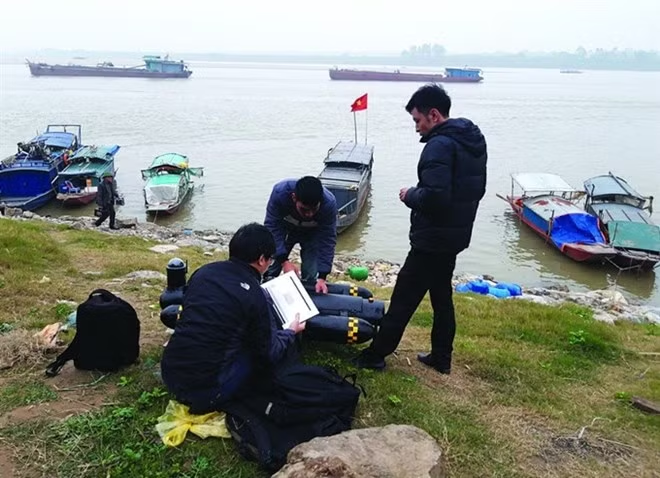
Researchers from the ViInstitute of Geodesy and Cartography prepare to test their seafloor mapping vehicle by the Hong (Red) River. The unmanned surface vehicles, developed in Vietnam, can gather data from areas of the ocean floor and river beds inaccessible to humans. (Photo: baotainguyenmoitruong.vn)

It performed well when tested in fast-flowing areas of the Lo and Da rivers and near the island district of Van Don in the coastal province of Quang Ninh, Tai nguyen Moi truong (Natural Resources) online newspaper reported.

The vehicle was created by researchers from the Vietnam Institute of Geodesy and Cartography under the Ministry of Natural Resources and Environment (MONRE) as a result of a project that is running from January 2018 to June 2020.

It operates with two systems that have never been successfully assembled in Vietnam before, according to Luu Hai Au, director of the institute’s Centre for Informatics and Geodesy.

They include a satellite positioning system running with virtual reference station (VRS) technology attached to an unmanned aerial vehicle and a software system that integrates echo sounding devices via an internal measurement unit, he said.

“The theories of operation of these two systems were thoroughly studied by MONRE and were proven effective after being put into production,” Au said.

"Mapping the topography of the ocean floor and river beds with echo sounding devices attached to unmanned surface vehicles is new to Vietnam, though the technique is practised worldwide," he said.

The unmanned surface vehicle would help create large-scale topographic maps of areas with dangerous terrain inaccessible to humans and those that are polluted, he said.

“It can also gather water pollution data and help to detect factories that release untreated waste into the environment,” said Au.

VNS/VNA

Other News

Hanoi approves controlled pilot of two technology projects

Hanoi approves controlled pilot of two technology projects

The two projects involve an intelligent autonomous transportation system developed by Phenikaa-X JSC and a technology for producing mixed rare-earth oxides with a purity of over 95% on a semi-industrial scale developed by the Mining Technology and Construction Consultancy JSC.

Banking industry in AI era: When data becomes competitive advantage

Banking industry in AI era: When data becomes competitive advantage

In just a few years, AI has evolved from an experimental technology into an “assistant” for many banks, supporting everything from customer service, credit approval, and fraud detection to risk management. However, as the technological gap between institutions narrows, a new question is emerging: What will determine banks' competitive advantage in the AI era?

Bac Ninh considers establishing AI centre of excellence

Bac Ninh considers establishing AI centre of excellence

A meeting has been held in Bac Ninh to discuss potential cooperation with Plug and Play in developing the northern province’s innovation ecosystem and establishing an artificial intelligence (AI) centre of excellence, with Standing Vice Chairman of the provincial People’s Committee Mai Son receiving a delegation from the global innovation platform.

Hanoi allows 24-month trial of autonomous vehicles at Hoa Lac

Hanoi allows 24-month trial of autonomous vehicles at Hoa Lac

The project aims to assess the safety, reliability and readiness of autonomous vehicles under real traffic conditions, as well as the effectiveness of autonomous public transport and compatibility with existing systems. Its results will contribute to developing technical standards, operating procedures and management models suited to Hanoi’s traffic conditions.

Singapore's experience suggests solutions to Vietnam's human resources challenge in AI era

Singapore's experience suggests solutions to Vietnam's human resources challenge in AI era

As Vietnam accelerates digital transformation and high-tech development, Singapore’s experience and the engagement of global technology companies demonstrate that human resources preparation must stay ahead of the curve. The ability to filter knowledge, collaborate, innovate and effectively use AI will increasingly become essential to helping workers adapt to a changing labour market and strengthening the competitiveness of Vietnam’s economy in the new era.

Protecting national security amid digital transformation, cyberspace

Protecting national security amid digital transformation, cyberspace

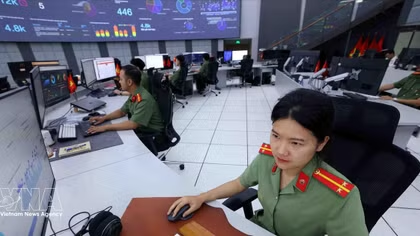
Cybersecurity, information security and data security risks must be identified and addressed early and from afar, with appropriate defensive measures ready to neutralise threats and protect national interests in cyberspace, said Lieutenant General Le Xuan Minh, Director of the Ministry of Public Security’s Department of Cybersecurity and Hi-tech Crime Prevention (A05).

Mekong Delta launches first robotics, AI research institute

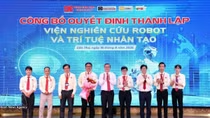
Mekong Delta launches first robotics, AI research institute

Dr. Nguyen Van Quang, Rector of Nam Can Tho University, said the university is developing a value chain covering training, research, technology development, testing, technology transfer and commercialisation. The model is designed to link research more closely with practical needs, ensuring that technologies generate products and products create value for society.

Vietnam positioned to harness AI wave, World Bank report says

Vietnam positioned to harness AI wave, World Bank report says

The WB report identifies Vietnam as one of the few economies outside the European Union (EU) to have adopted a comprehensive AI regulatory framework as early as 2025. Vietnam applies a risk-tiered approach similar to that of the EU AI Act, imposing different obligations depending on whether an AI system poses “unacceptable,” “high,” “low” or “minimal” risks. The approach is viewed as a strategic step towards ensuring safe and transparent AI governance.

AI offers both opportunities, challenges for Vietnam's growth

AI offers both opportunities, challenges for Vietnam's growth

Dr. Ho Duc Thang, a full-time member of the National Assembly’s Committee for Cultural and Educational, said productivity is the key to sustaining double-digit economic growth, and AI has greater potential to improve productivity than any previous technology.

Top leader unveils people-centred vision for new development model

Top leader unveils people-centred vision for new development model

Vietnam's growth model, long fueled by low-cost labour, resource extraction, contract manufacturing, expanded investment, and capital accumulation, has run out of road. The country now needs a sweeping reform agenda to shift from extensive growth to a model driven by productivity, knowledge, science and technology, innovation, and digital transformation.