Most ancient type of molecule in universe detected in space

The most ancient type of molecule in our universe has been detected in space, scientists have revealed, backing up theories of how the early chemistry of the universe developed after the big bang.

The positively charged molecule known as helium hydride is believed to have played a starring role in the early universe, forming when a helium atom shared its electrons with a hydrogen nucleus, or proton. Not only is it thought to be the first molecular bond, and first chemical compound, to have appeared as the universe cooled after the big bang, but it also opened up the path to the formation of molecules of hydrogen.

But while helium hydride was produced in the laboratory almost a century ago, it has proved elusive to detect in space, despite predictions that it should be present in gas clouds in which stars are born, as well as in gas expelled by stars as they die.

“Although [helium hydride] is of limited importance on Earth today, the chemistry of the universe began with this ion,” the authors write. “The lack of definitive evidence for its very existence in interstellar space has been a dilemma for astronomy.”
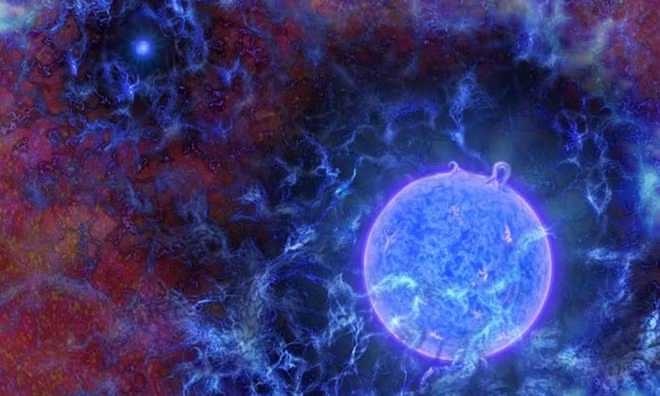
Helium hydride is thought to be the first stable chemical compound to have appeared after the big bang. Photograph: NR Fuller/Getty

Now experts say they have finally spotted helium hydride in a small but bright 600-year-old planetary nebula about 3,000 light years away in the constellation of Cygnus. While this helium hydride was formed by a different process to that in the early universe, the team say its presence backs up theories of what was going on at the “dawn of chemistry”, bringing a “decades-long search to a happy ending at last”.

Dr Jérôme Loreau, an expert in helium hydride from the Université Libre de Bruxelles, who was not involved in the study, said the findings were exciting, noting that although large organic molecules had been found in space, the much simpler helium hydride had proved difficult to track down.

“Another reason it is exciting is that HeH+ [helium hydride] is the first molecule ever to form in the universe, about 380,000 years after the big bang, in an era known as the recombination epoch,” said Loreau, adding that molecules that appeared in this period, as the universe cooled, later led to the formation of stars and galaxies. “It is therefore very exciting to have finally observed one of the building blocks of the molecular universe.”

One difficulty in detecting helium hydride is that telltale signs based on the light it emits after it is buffeted by electrons tend to be obscured by almost overlapping “signatures” from a different molecule composed of carbon and hydrogen, however, new instruments have turned up trumps.

Writing in the journal Nature, the team report they made their discovery by scrutinising a planetary nebula known as NGC 7027 in which layers of gas are being lost from its hot core – a white dwarf.

Data was collected using an instrument onboard a mission known as Sofia, a joint project between Nasa and the German Aerospace Center, in which a specially modified Boeing 747SP aircraft is flown very high up in the Earth’s atmosphere, up to about 13,700 metres (45,000ft), carrying a 2.7-metre telescope and other instruments. At this height, the instruments are above the vast majority of the Earth’s water vapour, which would otherwise obscure signals from other molecules.

Crucially, these instruments offer a very high resolution, allowing light from helium hydride to be distinguished from signatures of other molecules at very similar wavelengths.

Prof Phillip Stancil, an expert on helium hydride from the University of Georgia, also said the discovery was exciting, but pointed out only one “signature” of helium hydride was detected, and two are usually needed to be sure.

But Dr Rolf Güsten, from the Max Planck Institute for Radio Astronomy in Bonn, Germany, and first author of the research, said the chance of the identification being wrong is negligible, adding that the findings resolve a longstanding conundrum.

“The lack of evidence of the very existence of helium hydride in the local universe has called into question our understanding of the chemistry in the early universe,” he said. “The detection reported here resolves such doubts.
The Guardian

Other News

SK Group partners to build AI ecosystem in Vietnam

SK Group partners to build AI ecosystem in Vietnam

SK Innovation and SK Telecom signed MoUs with Nghe An province and the National Innovation Centre of Vietnam to advance AI ecosystem development and support the country’s long-term growth strategy.

Vietnam Research Excellence Fellowship for 2026-2030 approved

Vietnam Research Excellence Fellowship for 2026-2030 approved

Under the Vietnam Research Excellence Fellowship (VREF) for the 2026–2030 period, PhD students are identified as a core research force directly contributing to breakthroughs in sci-tech and innovation. Investing in top-tier doctoral candidates is more than workforce development, but a high-stakes strategic bet to forge a cohort of world-class scientists and technologists who can power Vietnam’s long-term economic ambitions.

Strategic tech must address practical challenges: PM

Strategic tech must address practical challenges: PM

Prime Minister Pham Minh Chinh on March 28 said strategic technologies must tackle Vietnam’s practical challenges, while chairing a meeting of the Government’s Steering Committee for science and technology, innovation, digital transformation, and Project 06.

Ho Chi Minh City sets sights on becoming semiconductor hub

Ho Chi Minh City sets sights on becoming semiconductor hub

Ho Chi Minh City is stepping up efforts to attract investment from global leading groups and companies in the fields of electronic components, semiconductors and chip manufacturing as it seeks to position itself as a leading semiconductor industry hub in both the region and the world. 

Ho Chi Minh City launches upgraded technology exchange platform

Ho Chi Minh City launches upgraded technology exchange platform

The upgraded platform represents a comprehensive shift from a simple information-sharing model to a managed online technology trading system, enabling monitoring and measurement of real transaction outcomes. It is built on three pillars, namely new tradable technology products, a modern digital platform, and an improved operational model.

AI – unmissable opportunity for Vietnam: Experts

AI – unmissable opportunity for Vietnam: Experts

AI also emerges as a key enabler for Vietnam's ambition to build financial and technology hubs. Applications can boost efficiency, automate workflows, cut costs, and sharpen data analytics, which are essential pillars of a modern financial system.

PM calls for accelerated space technology development in Vietnam

PM calls for accelerated space technology development in Vietnam

Vietnam aims by 2030 to achieve a mid-level position in space science and technology development within Southeast Asia, and after 2030 to build national capabilities to independently develop satellite technologies and apply space data to address global challenges and national security needs.

High-level forum advances Vietnam–US technological cooperation

High-level forum advances Vietnam–US technological cooperation

A high-level executive leadership forum focusing on strengthening Vietnam - US relations through technology cooperation was jointly held in Washington D.C. on March 11 by the Embassy of Vietnam in the US, the Weatherhead East Asian Institute of Columbia University, and the US -ASEAN Business Council (USABC). 

AI Law takes effect, anchors national governance framework

AI Law takes effect, anchors national governance framework

While many countries are still drafting policy blueprints or issuing non-binding guidance, Vietnam has moved ahead with a standalone Law on Artificial Intelligence (AI), effective from March 1, placing it among a select group of nations to adopt dedicated AI legislation at the parliamentary level. 

Vietnam International Defence Expo 2026 preparations move into high gear

Vietnam International Defence Expo 2026 preparations move into high gear

Vietnam International Defence Expo 2026, themed “Peace, Friendship, Cooperation and Development,” will be organised on a larger scale, featuring a wide array of weapons and technical equipment alongside product exhibitions, seminars and panel discussions, drills, live field demonstrations, and business networking activities.

Ministry requests urgent measures to counter UAVs threatening aviation safety

Ministry requests urgent measures to counter UAVs threatening aviation safety

Ministry of Construction requested the Ministry of National Defence, the Ministry of Public Security and provincial and municipal steering committees for counter-terrorism to strengthen the management, inspection and supervision of UAVs and other aerial devices, ensuring strict compliance with Decree No. 288/2025/ND-CP and relevant legal regulations.