Plasma from coronavirus survivors found to help severely ill patients

Doctors have found tentative evidence that seriously ill coronavirus patients can benefit from infusions of blood plasma collected from people who have recovered from the disease.

Two teams of medics working at separate hospitals in China gave antibody-rich plasma to 15 severely ill patients and recorded striking improvements in many of them.

In one pilot study, doctors in Wuhan gave “convalescent plasma” to 10 severely ill patients and found that virus levels in their bodies dropped rapidly. Within three days, the doctors saw improvements in the patients’ symptoms, ranging from shortness of breath and chest pains to fever and coughs.

Xiaoming Yang, from the National Engineering Technology Research Center for Combined Vaccines in Wuhan, described the treatment as a “promising rescue option” for severely ill patients, but cautioned that a larger randomised trial was needed to confirm the findings. Details of the pilot study are reported in Proceedings of the National Academy of Sciences.
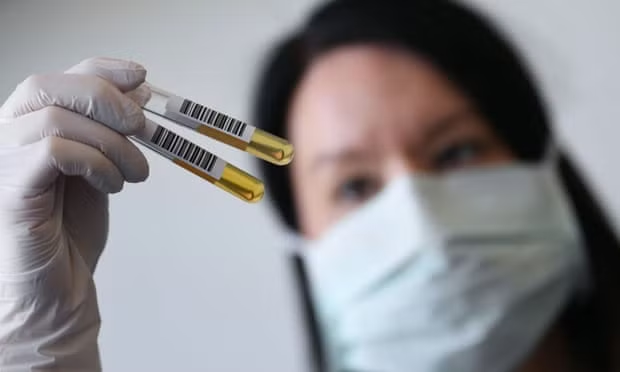
A researcher from University Hospital Erlangen, Germany, which has been granted permission to produce therapeutic plasma to treat critically ill Covid-19 patients. Photograph: Andreas Gebert/Reuters
 A researcher from University Hospital Erlangen, Germany, which has been granted permission to produce therapeutic plasma to treat critically ill Covid-19 patients. Photograph: Andreas Gebert/Reuters

Another team of doctors led by Lei Liu, from Shenzhen Third People’s hospital, gave convalescent plasma to five critically ill patients. All showed improved symptoms after the infusions and within 10 days, three patients were able to come off the ventilators that had been keeping them alive, according to a preliminary report in the Journal of the American Medical Association.

The findings raise hopes that donated blood from recently recovered patients could be used to boost the immune systems of more vulnerable people and help them fight the infection. But with only a small number of patients so far treated with plasma, and the infusions given outside of formal trials, it is impossible to know how much benefit the treatment really brings.

Convalescent plasma treatments date back to before the 1918 Spanish flu pandemic. The therapy relies on the fact that people who have recovered from a viral infection have antibodies in their blood that can rapidly detect and destroy the virus the next time it attacks. Infusing the plasma into patients, and potentially into people at risk of being infected, can boost their immune systems and potentially provide protection.

Hints that the therapy may help have prompted US doctors to trial infusions in the outbreak in New York and similar studies are expected to start in the UK in the coming weeks. Britain’s national blood service has begun screening blood from patients to find plasma rich in antibodies to use in those trials.

Professor David Tappin, a senior research fellow at the University of Glasgow, has applied to the UK’s National Institute for Health Research to run two clinical trials with convalescent plasma. They will look for evidence that plasma can protect frontline workers from infection, prevent patients from deteriorating and needing ventilation in intensive care units, and improve the condition of those who are already severely ill.

Tappin said the cases reported from Wuhan were important because they suggested that giving plasma to severely ill patients appeared to be safe. “The outcomes are also encouraging for these patients,” he said. But he added that to be sure plasma improved on the natural course of the disease, and that it was safe in larger groups of patients, formal trials had to take place.

Professor Munir Pirmohamed, the president of the British Pharmacological Society, echoed the need to be cautious about the Wuhan cases. “This was not a randomised trial and all patients also received other treatments including antivirals such as remdesivir, which are currently in trials for Covid-19,” he said.

“It is also important to remember that there are potential safety concerns with convalescent plasma, including transmission of other agents and antibody enhancement of disease,” he added. “Even if shown to work, scalability to treat large numbers of patients may become an issue.”
The Guardian

Other News

SK Group partners to build AI ecosystem in Vietnam

SK Group partners to build AI ecosystem in Vietnam

SK Innovation and SK Telecom signed MoUs with Nghe An province and the National Innovation Centre of Vietnam to advance AI ecosystem development and support the country’s long-term growth strategy.

Vietnam Research Excellence Fellowship for 2026-2030 approved

Vietnam Research Excellence Fellowship for 2026-2030 approved

Under the Vietnam Research Excellence Fellowship (VREF) for the 2026–2030 period, PhD students are identified as a core research force directly contributing to breakthroughs in sci-tech and innovation. Investing in top-tier doctoral candidates is more than workforce development, but a high-stakes strategic bet to forge a cohort of world-class scientists and technologists who can power Vietnam’s long-term economic ambitions.

Strategic tech must address practical challenges: PM

Strategic tech must address practical challenges: PM

Prime Minister Pham Minh Chinh on March 28 said strategic technologies must tackle Vietnam’s practical challenges, while chairing a meeting of the Government’s Steering Committee for science and technology, innovation, digital transformation, and Project 06.

Ho Chi Minh City sets sights on becoming semiconductor hub

Ho Chi Minh City sets sights on becoming semiconductor hub

Ho Chi Minh City is stepping up efforts to attract investment from global leading groups and companies in the fields of electronic components, semiconductors and chip manufacturing as it seeks to position itself as a leading semiconductor industry hub in both the region and the world. 

Ho Chi Minh City launches upgraded technology exchange platform

Ho Chi Minh City launches upgraded technology exchange platform

The upgraded platform represents a comprehensive shift from a simple information-sharing model to a managed online technology trading system, enabling monitoring and measurement of real transaction outcomes. It is built on three pillars, namely new tradable technology products, a modern digital platform, and an improved operational model.

AI – unmissable opportunity for Vietnam: Experts

AI – unmissable opportunity for Vietnam: Experts

AI also emerges as a key enabler for Vietnam's ambition to build financial and technology hubs. Applications can boost efficiency, automate workflows, cut costs, and sharpen data analytics, which are essential pillars of a modern financial system.

PM calls for accelerated space technology development in Vietnam

PM calls for accelerated space technology development in Vietnam

Vietnam aims by 2030 to achieve a mid-level position in space science and technology development within Southeast Asia, and after 2030 to build national capabilities to independently develop satellite technologies and apply space data to address global challenges and national security needs.

High-level forum advances Vietnam–US technological cooperation

High-level forum advances Vietnam–US technological cooperation

A high-level executive leadership forum focusing on strengthening Vietnam - US relations through technology cooperation was jointly held in Washington D.C. on March 11 by the Embassy of Vietnam in the US, the Weatherhead East Asian Institute of Columbia University, and the US -ASEAN Business Council (USABC). 

AI Law takes effect, anchors national governance framework

AI Law takes effect, anchors national governance framework

While many countries are still drafting policy blueprints or issuing non-binding guidance, Vietnam has moved ahead with a standalone Law on Artificial Intelligence (AI), effective from March 1, placing it among a select group of nations to adopt dedicated AI legislation at the parliamentary level. 

Vietnam International Defence Expo 2026 preparations move into high gear

Vietnam International Defence Expo 2026 preparations move into high gear

Vietnam International Defence Expo 2026, themed “Peace, Friendship, Cooperation and Development,” will be organised on a larger scale, featuring a wide array of weapons and technical equipment alongside product exhibitions, seminars and panel discussions, drills, live field demonstrations, and business networking activities.

Ministry requests urgent measures to counter UAVs threatening aviation safety

Ministry requests urgent measures to counter UAVs threatening aviation safety

Ministry of Construction requested the Ministry of National Defence, the Ministry of Public Security and provincial and municipal steering committees for counter-terrorism to strengthen the management, inspection and supervision of UAVs and other aerial devices, ensuring strict compliance with Decree No. 288/2025/ND-CP and relevant legal regulations.