Powerful Next-Gen Weather Satellite Launches to Begin Forecasting 'Revolution'

A powerful new satellite that will give forecasters their best-ever looks at storms and other severe weather has taken to the skies.

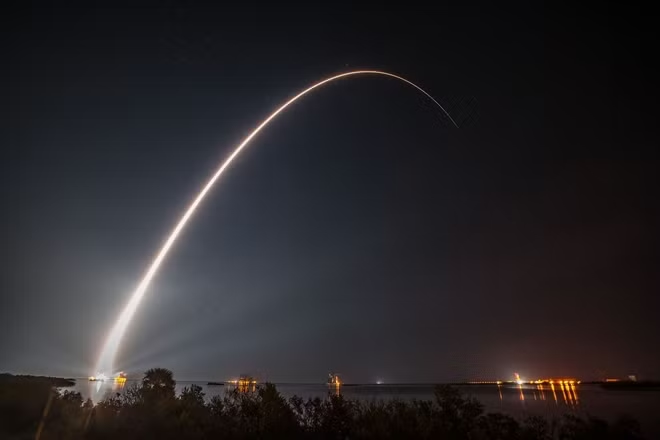
The GOES-R weather satellite lifted off from Florida's Cape Canaveral Air Force Station today (Nov. 19) at 6:42 p.m. EST (2342 GMT), riding a United Launch Alliance Atlas V rocket to orbit. The spectacular launch, which lit up the Florida evening sky, occurred about one hour later than planned due to issues with the rocket and launch range that were swiftly resolved.

GOES-R is the first of four new advanced weather satellites that are, somewhat confusingly, collectively known as GOES-R. The U.S. National Oceanic and Atmospheric Administration (NOAA), which manages the GOES-R program, is expecting big things from all four of these spacecraft.
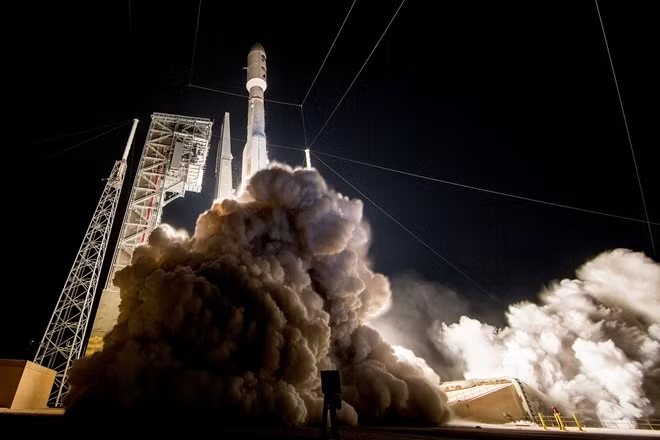
The GOES-R satellite streaks into space aboard an Atlas V rocket in this long-exposure view of its successful launch from Cape Canaveral Air Force Station in Florida on Nov. 19, 2016. Photo: United Launch Alliance

GOES-R is the 16th GOES (Geostationary Operational Environmental Satellite) craft to make it to space — and the satellite will be renamed GOES-16 when it reaches its final orbit, about two weeks from now. GOES satellites have been studying weather patterns from above for more than four decades; GOES-1 launched way back in October 1975. Two GOES craft, known as GOES-East and GOES-West based on their orbital positions, are doing this work now; a third GOES spacecraft is also aloft and serves as an on-orbit spare. [

The GOES satellites operate from geostationary orbit, about 22,300 miles (35,890 kilometers) above Earth's surface along the equator. At this altitude, their orbital speeds match the rotational speed of Earth, so the spacecraft can keep continuous tabs on the same stretch of land. In this case, that means the United States and much of the rest of the Western Hemisphere.
Artist's illustration of the GOES-R weather satellite in space. GOES-R launched on Nov. 19, 2016, and will reach its final geostationary orbit about two weeks later (at which point its name will change to GOES-16). Photo: NASA

GOES-R will gather three times more data, with four times higher resolution, than comparable gear on GOES-East and GOES-West. And ABI will be able to scan the landscape five times faster to boot, NOAA officials said.

GOES-R is also the first satellite to carry a lightning mapper to geostationary orbit. This instrument will photography lightning activity throughout the Western Hemisphere about 200 times every second, NOAA officials said.

GOES-R should also increase the accuracy of forecasts in the space-weather realm, Mandt added. One of the satellite's instruments will image the surface of the sun, for instance, while others will monitor the amount of energy coming from the star and the activity of charged particles zooming near Earth.
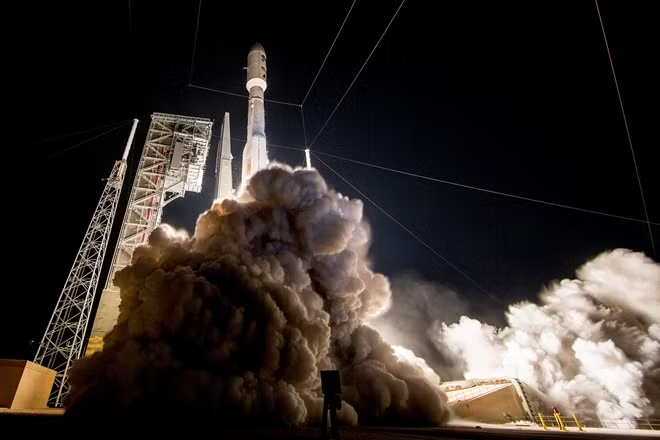
A United Launch Alliance Atlas V rocket launches the advanced new GOES-R weather satellite into orbit from Space Launch Complex 41 at Cape Canaveral Air Force Station, Florida on Nov. 19, 2016. Photo: United Launch Alliance

A United Launch Alliance Atlas V rocket launches the advanced new GOES-R weather satellite into orbit from Space Launch Complex 41 at Cape Canaveral Air Force Station, Florida on Nov. 19, 2016. Photo: United Launch Alliance

GOES-R is designed to operate for 10 years, though it has enough fuel on board to last for 18 years, Volz said. The three GOES-R satellites yet to begin their missions — currently known as GOES-S, GOES-T and GOES-U — are scheduled to launch in 2018, 2019 and 2024, respectively.

This staggered slate should ensure that two satellites will continue collecting high-quality weather data as GOES-East and GOES-West through at least 2036, Mandt said.

The GOES-R program has a total budget of $10.8 billion through its entire life cycle, which runs from 2005 (when development began) through 2036. The project had already spent about $6.1 billion by the end of fiscal year 2015, NOAA officials have said.

The aerospace company Lockheed Martin is building the four GOES-R satellites. NOAA manages the GOES-R program, with assistance from NASA.


Space.com

Other News

Vietnam targets at least 10 large strategic technology firms by 2030

Vietnam targets at least 10 large strategic technology firms by 2030

Deputy Prime Minister Ho Quoc Dung has signed a decision approving a plan to develop large domestic strategic technology enterprises in the 2026–2030 period, aimed at advancing digital infrastructure, digital human resources, digital data, strategic technologies and cybersecurity.

Protecting users crucial in building digital trust: Experts

Protecting users crucial in building digital trust: Experts

In Vietnam, digital transformation in the finance and banking sector is accelerating cashless payments, expanding access to financial services, improving market transparency and supporting economic growth and macroeconomic management.

Fostering skilled workforce for innovation era: experts

Fostering skilled workforce for innovation era: experts

Experts said close coordination among State management agencies, research institutes, universities, and businesses will improve training quality and serve the dual goals of quality education and practical research application.

Startup forum bridges Silicon Valley and local innovation ecosystem

Startup forum bridges Silicon Valley and local innovation ecosystem

The University of Economics Ho Chi Minh City (UEH), Saigon Asset Management (SAM), and Plug and Play Tech Centre co-hosted the “From Vietnam to Silicon Valley” forum, exploring AI innovation, venture capital, and pathways to integrate Vietnam’s startup ecosystem with Silicon Valley and global markets.

Experts call for stronger action against fake news online

Experts call for stronger action against fake news online

Experts have warned that fake news, misinformation and harmful online content are increasingly shaping public perceptions, particularly among young people, and stressed the need for stronger legal safeguards, technology tools and wider dissemination of credible information to tackle the problem effectively.

Protecting digital future in post-quantum, AI era

Protecting digital future in post-quantum, AI era

Participants highlighted the importance of building a proactive, synchronised and sustainable national cybersecurity ecosystem through closer cooperation among regulators, technology firms, research institutions and cybersecurity experts.

Vietnam attends SAHA 2026 defence, aerospace exhibition in Türkiye

Vietnam attends SAHA 2026 defence, aerospace exhibition in Türkiye

Vietnam’s participation in SAHA 2026 International Defence & Aerospace Exhibition in Istanbul reflects the country’s consistent policy of enhancing international defence integration and promoting defence industry cooperation towards self-reliance, self-strengthening, modernisation and dual-use development.

SK Group partners to build AI ecosystem in Vietnam

SK Group partners to build AI ecosystem in Vietnam

SK Innovation and SK Telecom signed MoUs with Nghe An province and the National Innovation Centre of Vietnam to advance AI ecosystem development and support the country’s long-term growth strategy.

Vietnam Research Excellence Fellowship for 2026-2030 approved

Vietnam Research Excellence Fellowship for 2026-2030 approved

Under the Vietnam Research Excellence Fellowship (VREF) for the 2026–2030 period, PhD students are identified as a core research force directly contributing to breakthroughs in sci-tech and innovation. Investing in top-tier doctoral candidates is more than workforce development, but a high-stakes strategic bet to forge a cohort of world-class scientists and technologists who can power Vietnam’s long-term economic ambitions.