Retailers: Keeping pace with accelerating change in 2017

The coming year will be another challenging one for domestic sector retailers as they seek to maintain market share and compete with the growing foreign sector for sales revenue, said experts at a recent business forum in Hanoi.

Dr Luu Duc Hai of the Ministry of Planning and Investment said that based on what has happened in 2016, it could be argued that next year would be even more challenging.

Dr Hai said more aggressive marketing strategies are needed by local companies as they try to carve out a niche in the retail market, adding that he believes the major battlegrounds would shift to online shopping.

Online shopping, said Dr Hai, offers a more cost-effective channel to reach select targeted consumer groups.
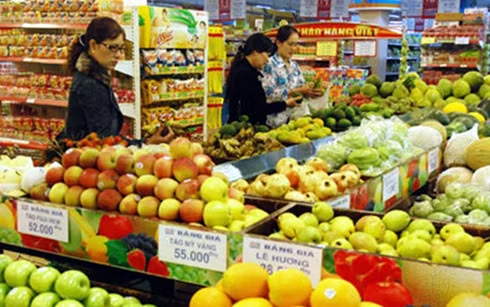
The retail sector can also expect to see more intense price competition, in an industry that is already operating on thin gross profit margins.

It therefore becomes critically important for companies to not only channel the right market but effectively manage their resources, particularly in keeping inventory and product mix at optimum levels.

Excessive amounts of inventory have advantages and disadvantages for a business, which makes inventory control a delicate balancing act.

When a company holds a high level of inventory, it ties up business funds that could be used in other areas such as research and development or marketing. It also leads to higher warehousing costs and can lead to quality problems such as degradation and potential obsolescence.

However, not having enough of an item on hand can lead to lost sales from not having an item to fill a customer order and can also lead to customer dissatisfaction and customer loss as they go to a competitor to acquire the product.

Another consideration, said Dr Hai, is that small retailers can obtain a savings when purchasing many products in bulk quantities. Many suppliers give larger discounts to customers who order larger quantities.

Dr Doan Thi Thuy Duong of the Ministry of Planning and Investment in turn agreed that 2017 would be a particularly challenging year for domestic sellers in the country.

Dr Duong said consumer behaviour had changed in 2016, particularly with the advent of online shopping and the implementation of novel online-purchasing models throughout the country.

She noted that major challenges for local retailers would evolve around gaining a better understanding of consumer buying habits and realizing that they are changing at a dramatically fast pace.

The country’s retail markets are moving into the digital age and a whole new era of interactive online marketing is beginning to emerge. It just may be that the key to success of domestic sector companies for 2017 depends upon their ability to tap into this behaviour and cater to it better than their foreign sector counterparts.

Clinging to outdated sales and marketing strategies would most likely not be successful in 2017, she underscored.

Dr Hai noted that complex challenges for retailers lie ahead in the coming year as they struggle to develop differing strategies to target the diversity of target consumer groups.

Not only online shopping is having a significant impact on the retail market, added Dr Hai, but the demographics are changing as more young people, foreign business people and tourists impact the consumer mix.

The increased complexity of the consumer mix complicates marketing activities and it just may be that the most successful companies for 2017 are the ones that can best understand and adapt their company policies.

Lastly, Mr Hai commented that another emerging challenge facing domestic sector retailers is in coping with new payment methods as well as how they deliver products and services to the consumer.

VOV

Other News

SBV raises short-term capital lending cap to 40%

SBV raises short-term capital lending cap to 40%

The new circular will help credit institutions have more room to provide capital to businesses and investment projects to support high economic growth in the next few years, while increasing flexibility in the SBV’s monetary policy management.

Business confidence in Vietnam rebounds strongly: UOB

Business confidence in Vietnam rebounds strongly: UOB

The study found that 85% of Vietnamese enterprises reported positive business sentiment, a sharp increase from 48% in 2025, when business confidence was weighed down by uncertainties surrounding US tariff policies and related trade developments.

Bac Ninh seeks high-quality foreign investment for sustainable growth

Bac Ninh seeks high-quality foreign investment for sustainable growth

According to Vice Chairman of the provincial People’s Committee Pham Van Thinh, the province aims to maintain stable and sustainable growth, improve the competitiveness of both the economy and local businesses, and make better use of free trade agreements (FTAs) to expand and diversify export markets.

Green building trend flourishes in Ho Chi Minh City's real estate landscape

Green building trend flourishes in Ho Chi Minh City's real estate landscape

The International Finance Corporation (IFC) highlighted the city's dominance in green-certified building floor space in Vietnam, reflecting the rapid expansion of the green building market with 780 completed green buildings encompassing over 18.69 million sq.m by 2025, predominantly certified by EDGE and LEED.

UK supports Vietnam in wind power and green finance development

UK supports Vietnam in wind power and green finance development

The United Kingdom officially announced two new climate cooperation initiatives to support Vietnam in its energy transition and green growth journey. These programs focus on offshore wind power development and the creation of a sustainable green financial ecosystem.

Ample room remains for Vietnam–India logistics cooperation

Ample room remains for Vietnam–India logistics cooperation

The GTTCI expert noted that alongside logistics and integrated warehousing, e-commerce is expected to be a particularly high-growth sector in the coming years. He described it as a multi-billion-dollar market with significant untapped opportunities for cooperation between Vietnam and India.

Exports gain momentum from high-tech growth drivers

Exports gain momentum from high-tech growth drivers

According to the Ministry of Industry and Trade, Vietnam’s exports reached 215.66 billion USD in the first five months of 2026, up 19.5% year-on-year. Twenty-six export items generated more than 1 billion USD in revenue each, including seven with turnover exceeding 10 billion USD.

Vietnam–China crossings see spike in ASEAN fresh produce

Vietnam–China crossings see spike in ASEAN fresh produce

Since the start of the summer harvest season, China's two major border gates with Vietnam, Youyi Guan in Pingxiang and Beilun 2 Bridge in Dongxing, have entered their peak period for handling imports of fresh agricultural and seafood products from member states of the Association of Southeast Asian Nations (ASEAN).

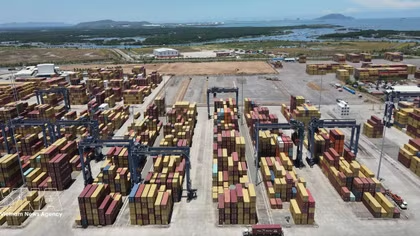
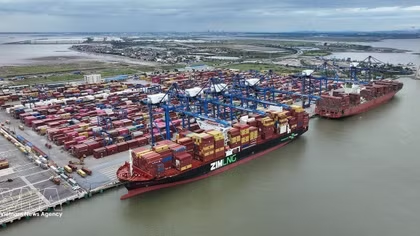
Cargo handling operations at Berths 3 and 4 of the Hai Phong International Gateway Port. (Photo: VNA)

AI reshapes logistics, raising bar for workforce skills

According to the Vietnam Logistics Business Association (VLA), the logistics sector will require around 2.2 million workers by 2030, including 1.6 million employees for logistics service providers and nearly 600,000 personnel supporting logistics operations in manufacturing and trading enterprises.

Robust dispute resolution framework key to Vietnam's IFC ambitions

Robust dispute resolution framework key to Vietnam's IFC ambitions

The development strategy for VIFC-HCMC envisions a comprehensive financial ecosystem encompassing green finance, carbon credits, financial technology (fintech), blockchain technology, digital assets, digital banking and other innovative business models. These highly internationalised sectors involve complex cross-border transactions and sophisticated legal structures.