Scientists make ultra-strong metallic glasses more pliable by freezing

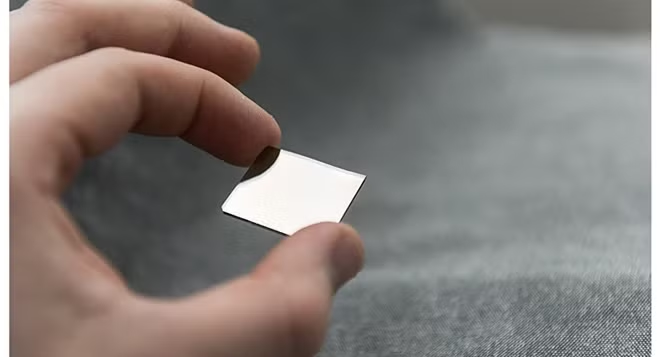
Scientists at the National University of Science and Technology MISIS have used the cryo-thermal cycling method on metallic glasses and found that the glasses became more pliable without losing their original strength.

An article on this research was published in NPG Asia Materials.

Metallic glasses (or amorphous alloys) are used in magnetic materials, medical instruments, micromotors' gear wheels, sports equipment, and elsewhere. This kind of glass is very durable and resistant to both wear and rust.

But all metallic glasses lack plasticity (or are fragility-prone). This defect is removed through rejuvenation or conversion to a higher energy state that increases resistance to plastic deformation without the loss of strength.
Scientists at the NUST MISIS, jointly with Sergey Ketov (a NUST MISIS graduate) studied how cryo-thermal cycling, a method of cyclical liquid-nitrogen cooling,  affected the properties of metallic glasses and came to the conclusion that it could stimulate both "the rejuvenation and relaxation (a reverse process) of metallic glasses," Tohoku University professor and research advisor Dmitri Luzgin said.

Atomic force microscopy reveals that cryo-thermal cycling can also dramatically increase stretch or compression resistance on a material's surface (in a thin layer of dozens of nanometers) when it is subjected to elastic strain.

However, this effect disappears after a period of room temperature aging. The effect on volume, on the other hand, remains and improves plasticity.        

"Cryo-thermal cycling seems to be a universal and simple method for changing the properties, rejuvenation or relaxation of metallic glasses. The important thing is that it can both improve and degrade plasticity. The method requires a careful selection of the composition of the alloys, based on the structure of atomic bonds in a sample," he said.

The team members say they will continue to study how this treatment affects the structure and properties of different materials. The "refinement" of the process will make it possible to increase the plasticity of both bulk metallic glasses and metallic glass-crystal composites (with the composites, rejuvenation can be even stronger on account of their heterogeneous structure).    
Sputnik

Other News

Vietnam targets at least 10 large strategic technology firms by 2030

Vietnam targets at least 10 large strategic technology firms by 2030

Deputy Prime Minister Ho Quoc Dung has signed a decision approving a plan to develop large domestic strategic technology enterprises in the 2026–2030 period, aimed at advancing digital infrastructure, digital human resources, digital data, strategic technologies and cybersecurity.

Protecting users crucial in building digital trust: Experts

Protecting users crucial in building digital trust: Experts

In Vietnam, digital transformation in the finance and banking sector is accelerating cashless payments, expanding access to financial services, improving market transparency and supporting economic growth and macroeconomic management.

Fostering skilled workforce for innovation era: experts

Fostering skilled workforce for innovation era: experts

Experts said close coordination among State management agencies, research institutes, universities, and businesses will improve training quality and serve the dual goals of quality education and practical research application.

Startup forum bridges Silicon Valley and local innovation ecosystem

Startup forum bridges Silicon Valley and local innovation ecosystem

The University of Economics Ho Chi Minh City (UEH), Saigon Asset Management (SAM), and Plug and Play Tech Centre co-hosted the “From Vietnam to Silicon Valley” forum, exploring AI innovation, venture capital, and pathways to integrate Vietnam’s startup ecosystem with Silicon Valley and global markets.

Experts call for stronger action against fake news online

Experts call for stronger action against fake news online

Experts have warned that fake news, misinformation and harmful online content are increasingly shaping public perceptions, particularly among young people, and stressed the need for stronger legal safeguards, technology tools and wider dissemination of credible information to tackle the problem effectively.

Protecting digital future in post-quantum, AI era

Protecting digital future in post-quantum, AI era

Participants highlighted the importance of building a proactive, synchronised and sustainable national cybersecurity ecosystem through closer cooperation among regulators, technology firms, research institutions and cybersecurity experts.

Vietnam attends SAHA 2026 defence, aerospace exhibition in Türkiye

Vietnam attends SAHA 2026 defence, aerospace exhibition in Türkiye

Vietnam’s participation in SAHA 2026 International Defence & Aerospace Exhibition in Istanbul reflects the country’s consistent policy of enhancing international defence integration and promoting defence industry cooperation towards self-reliance, self-strengthening, modernisation and dual-use development.

SK Group partners to build AI ecosystem in Vietnam

SK Group partners to build AI ecosystem in Vietnam

SK Innovation and SK Telecom signed MoUs with Nghe An province and the National Innovation Centre of Vietnam to advance AI ecosystem development and support the country’s long-term growth strategy.

Vietnam Research Excellence Fellowship for 2026-2030 approved

Vietnam Research Excellence Fellowship for 2026-2030 approved

Under the Vietnam Research Excellence Fellowship (VREF) for the 2026–2030 period, PhD students are identified as a core research force directly contributing to breakthroughs in sci-tech and innovation. Investing in top-tier doctoral candidates is more than workforce development, but a high-stakes strategic bet to forge a cohort of world-class scientists and technologists who can power Vietnam’s long-term economic ambitions.