Scientists nearly eliminate HIV reservoirs in patients using stem cells

Spanish scientists found huge reductions in the HIV-1 (Human Immunodeficiency Virus) reservoirs of five patients who underwent stem cell transplant treatment, according to research published Tuesday in the Annals of Internal Medicine Journal.

Latent HIV reservoirs are the cells of the body where HIV is able to persist even when patients are undergoing antiretroviral therapy. If someone diagnosed with HIV does not take their HIV antiretroviral medication, the amount of HIV in their body (called the viral load) will increase. Although antiretroviral drugs can suppress HIV viral loads, they cannot completely eliminate latent HIV reservoirs. 
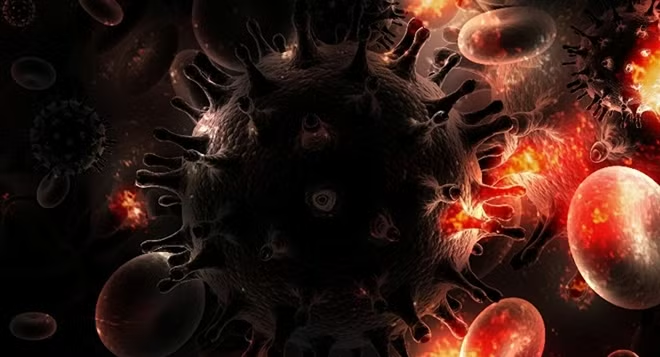
HIV reservoirs are where the cells that produce HIV infected cells hide out — antiretroviral drugs can suppress the infected cells they produce, but cannot actually flush out the reservoirs themselves. These HIV harboring reservoirs persist in the body even after antiretroviral medication decreases viral loads to undetectable levels.

However, according to researchers from the IrsiCaixa Institute for AIDS Research in Barcelona and the Gregorio Maranon Hospital in Madrid, stem cell transplant treatment was able to significantly reduce the HIV reservoirs of five patients to less than 0.006 infectious units per million cells. Viral loads that are less than 50 copies of HIV per milliliter of blood are considered "undetectable."

The scientists gave their patients allogeneic stem cell transplants, a procedure in which a person receives blood-forming stem cells from umbilical cords and bone marrow of genetically similar donors.

According to the report, analysis of the viral reservoirs showed that five out of the six patients in the study had undetectable HIV RNA (which measures the level of antibodies that fight HIV) in their blood and all six had undetectable HIV viral loads in their cerebrospinal fluid. The only participant with detectable HIV RNA received umbilical cord blood stem cells with an antithymocyte globulin, which is an infusion of horse or rabbit-derived antibodies against human T cells (a type of white blood cells that play an important role in cell immunity). It is unclear from the abstract of the report what kind of stem cells the other patients received.

The study was inspired by Timothy Brown, an American considered to be the first and only person to be cured of HIV. He is often referred to as "The Berlin Patient" because he was diagnosed with the virus in 1995 while studying in Berlin, Germany.

Brown's HIV was cured after he underwent a procedure known as a hematopoietic stem cell transplantation to treat his leukemia in 2007. The procedure involves the transplantation of multipotent stem cells usually derived from bone marrow, peripheral blood or umbilical cord blood.

Brown's donor had a mutation called CCR5 Delta 32, which makes blood cells immune to HIV by blocking the virus from attaching to them. After the procedure, Brown stopped taking his antiretroviral medication, and to this day, he remains completely free of HIV.
Sputnik

Other News

Vietnam targets at least 10 large strategic technology firms by 2030

Vietnam targets at least 10 large strategic technology firms by 2030

Deputy Prime Minister Ho Quoc Dung has signed a decision approving a plan to develop large domestic strategic technology enterprises in the 2026–2030 period, aimed at advancing digital infrastructure, digital human resources, digital data, strategic technologies and cybersecurity.

Protecting users crucial in building digital trust: Experts

Protecting users crucial in building digital trust: Experts

In Vietnam, digital transformation in the finance and banking sector is accelerating cashless payments, expanding access to financial services, improving market transparency and supporting economic growth and macroeconomic management.

Fostering skilled workforce for innovation era: experts

Fostering skilled workforce for innovation era: experts

Experts said close coordination among State management agencies, research institutes, universities, and businesses will improve training quality and serve the dual goals of quality education and practical research application.

Startup forum bridges Silicon Valley and local innovation ecosystem

Startup forum bridges Silicon Valley and local innovation ecosystem

The University of Economics Ho Chi Minh City (UEH), Saigon Asset Management (SAM), and Plug and Play Tech Centre co-hosted the “From Vietnam to Silicon Valley” forum, exploring AI innovation, venture capital, and pathways to integrate Vietnam’s startup ecosystem with Silicon Valley and global markets.

Experts call for stronger action against fake news online

Experts call for stronger action against fake news online

Experts have warned that fake news, misinformation and harmful online content are increasingly shaping public perceptions, particularly among young people, and stressed the need for stronger legal safeguards, technology tools and wider dissemination of credible information to tackle the problem effectively.

Protecting digital future in post-quantum, AI era

Protecting digital future in post-quantum, AI era

Participants highlighted the importance of building a proactive, synchronised and sustainable national cybersecurity ecosystem through closer cooperation among regulators, technology firms, research institutions and cybersecurity experts.

Vietnam attends SAHA 2026 defence, aerospace exhibition in Türkiye

Vietnam attends SAHA 2026 defence, aerospace exhibition in Türkiye

Vietnam’s participation in SAHA 2026 International Defence & Aerospace Exhibition in Istanbul reflects the country’s consistent policy of enhancing international defence integration and promoting defence industry cooperation towards self-reliance, self-strengthening, modernisation and dual-use development.

SK Group partners to build AI ecosystem in Vietnam

SK Group partners to build AI ecosystem in Vietnam

SK Innovation and SK Telecom signed MoUs with Nghe An province and the National Innovation Centre of Vietnam to advance AI ecosystem development and support the country’s long-term growth strategy.

Vietnam Research Excellence Fellowship for 2026-2030 approved

Vietnam Research Excellence Fellowship for 2026-2030 approved

Under the Vietnam Research Excellence Fellowship (VREF) for the 2026–2030 period, PhD students are identified as a core research force directly contributing to breakthroughs in sci-tech and innovation. Investing in top-tier doctoral candidates is more than workforce development, but a high-stakes strategic bet to forge a cohort of world-class scientists and technologists who can power Vietnam’s long-term economic ambitions.