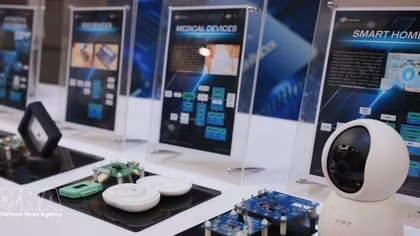
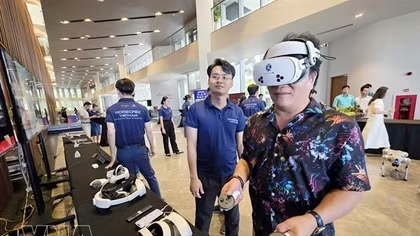
The scale of this market hit more than 600 billion USD last year, and is forecast to reach 1.4 trillion USD by 2029.
Vietnam is a very open economy, with total import-export turnover reaching 200 per cent of GDP, making the economy vulnerable to external fluctuations, said experts.
Economic expert Nguyen Dinh Cung, former director of the Central Institute for Economic Management (CIEM) told Doanh Nhan Viet Nam (Vietnamese Businessman) online magazine that Vietnam’s economy was very open and was becoming more and more open. Therefore, the economy was susceptible to even external factors.
Finding a solution to this problem, experts say that to avoid external injuries, Vietnam needs to change soon.
Pointing out the weakness of the Vietnamese economy, Cung said there were three important components including the FDI enterprise sector, the private sector and the State-owned enterprise sector.
However, these sectors had not been closely linked and unified with each other, said Cung.
To enhance the economy's resilience to external factors, these components needed to be more closely linked, he said.
When exports tended to weaken, they need support from the domestic market and vice versa, he added.
Cung predicted that the economy would continue to have an important driving force from the FDI and export sectors in the future, but for sustainable development, fundamental changes were needed.
“To attract FDI and improve export growth, we must not continue to rely on the advantage of low prices,” he said, adding major countries are currently tending to change their thinking and strengthen their foundations.
These countries are increasing their self-reliance in controlling the supply chain by moving factories to their home country or closer countries, which has caused a significant impact on the supply chain.
The good news is that Vietnam’s position is increasingly growing as it had become an important partner of many large countries, said experts.
The country has also just upgraded its relationship with the US to the level of a comprehensive strategic partnership.
This event has opened up many opportunities for Vietnam, especially in attracting investment in fields with high technology content and high added value such as the semiconductor industry.
Recently, leading US businesses and corporations in the field of semiconductors also assessed that Vietnam has many potentials and opportunities to develop the semiconductor industry ecosystem.
These businesses also said they were studying the possibility of locating chip factories in Vietnam.
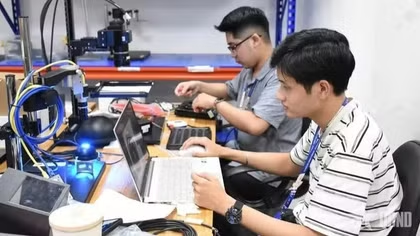
At the recent visit of US President Joe Biden, many large US semiconductor businesses such as Intel, Amkor, Marvell, and GlobalFoundries signed a commitment to invest in Vietnam. They assess that high-quality human resources and the improving capacity of businesses and training facilities in Vietnam are the necessary factors, not cheap human resources.
It can be seen that the trend of competing with cheap human resources has passed. Previously, Vietnam’s initial investment and export activities were mostly in low value-added sectors such as textiles, garments and footwear.
After that, the country has quickly moved up the value chain, developing into an important electronics assembly centre thanks to the investment participation of a number of technology "giants".
Typically, Samsung, up to now, its investment has reached 18 billion USD, accounting for about one-quarter of Vietnam’s export value.
This has also encouraged other tech giants, especially Apple, to expand their operations.
However, experts assessed that to maintain export momentum, it was necessary to attract and develop fields with high technology content such as the semiconductor industry because this was the leading trend in the future.
The scale of the global chip market was about more than 600 billion USD last year, and it was forecasted that it would reach 1,400 billion by 2029, an opportunity for Vietnam in this huge giant cake, said Nguyen Mai, Chairman of the Vietnam Association of Foreign Invested Enterprises (VAFIE).
Semiconductor technology is a 'story of the whole world', developed countries were giving incentives to expand research and production for this industry, said Mai.
Vietnam did not have much money to invest, so it had to rely on FDI capital attraction for development, he added.
Samsung and Intel are two electronics giants and also leading enterprises in the semiconductor industry.
Intel has increased the investment capital of this project to nearly 1.5 billion USD in 2021, and is planning to invest more to expand the factory in Vietnam.
Samsung also announced plans to produce semiconductor components in Vietnam. Mass production of semiconductor chip grid products at Samsung Electro-Mechanics Vietnam factory in Thai Nguyen province is expected to be carried out at the end of this year, after trial production is completed.
Two prominent semiconductor projects this year are the Hana Micron Vina factory in Bac Giang province, which has just been inaugurated, and Amkor Technology in Bac Ninh province, which is expected to be completed in October.
Choi Chang Ho, Chairman of Hana Micron Vina, said that the company planned to increase its total investment to over 1 billion USD by 2025, annual revenue is expected to reach 800 million USD and create 4,000 jobs for Vietnamese.
 Favourable visa policy offers fresh impetus to local tourism industry
  Vietnam-Korea seek cooperation on registration, green industry