Startup businesses still thirsty for capital

 Access to sufficient capital resources is crucial to the successful operations of businesses in addition to good ideas, proper business models and strategies, and qualified personnel.

The favourable business environment of Vietnam along with numerous incentive polices have offered optimal conditions for more and more enterprises to launch startups with their feasible ideals for new products.

However, the fact shows that many are still managing themselves to look for capital inflow, which is seen as a key factor behind their smooth operations.
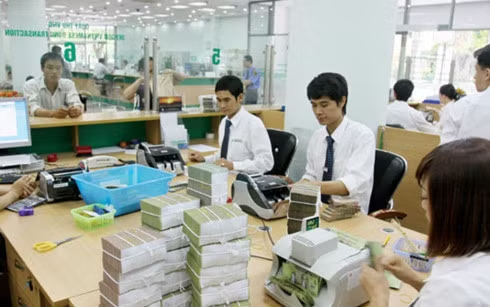
Startup businesses still thirsty for capital ảnh 1
Startup businesses still thirsty for capital

Nguyen Sac Phong, Project Director of the Green Farm Import Export Joint Stock Company in HCM City, says his company began operations in the field of organic agriculture in 2016 and since then its key products and services have been sold well in the domestic market.

Phong says initially he plans to expand this business model but failed on the back of capital shortage despite his best efforts to seek funding from multiple sources.

Vu Thien Hoang also faced the same situation when he came up with a business ideal for cosmetics and imported food. Hoang had to get along with capital mobilization from his friends and relatives and seek reputable suppliers during the startup process.

“If you do not have money in your hands, all ideas will get stuck,” he shares.

Actually, startup businesses usually only have in-depth knowledge about projects, products, areas of production and business but lack the skills to call for investment and basic knowledge about various related fields such as finance and administration.

In addition, many businesses are often impatient in persuading investment funds to lend them money and most banks set a series of rigid loan conditions that startups find difficult to meet.

Phan Dinh Tue, Deputy General Director of Saigon Thuong Tin Commercial Joint Stock Bank (Sacombank) says his bank is still in the process of building exclusive regulations for startup businesses.

According to some economic experts, the capital for startup businesses can still be found from banks and investment funds. The question is to have the knowledge and skills to call capital inflows from commercial banks and investment support funds.

There are many investors and private equity funds that startups can ask for help if their projects are proved to have great potential for development.

Ho Trong Lai from US financial advisory firm Waterstone Capital Partners LLC in Asia says if a start-up business wants to call for investment capital it is required to outline a specific project on personnel and capital using plans.

Many policies on streaming administrative procedures have been adopted, making it easier for businesses to embark on startups. The crux of the matter is how to ensure sufficient capital. It is now time for commercial banks to give a helping hand to startup businesses by setting appropriate lending criteria.

The Ministry of Planning and Investment (MPI) has set up the Startup Assistance Fund with a chartered capital of VND2,000 billion with a view to supporting startups but it is essential to define the right target and how much stakeholders will be involved in and how much will be provided by the fund.

Additionally, startups should stay more active in looking for investment funds or adventurous investors as the better way to help deal with capital shortage.
VOV

Other News

Vietnam – one of most attractive destinations for leading US semiconductor companies: expert

Vietnam – one of most attractive destinations for leading US semiconductor companies: expert

Vietnam has built a solid semiconductor and electronics industry before joining ITSI, attracting major US semiconductor companies. Intel Products Vietnam is one of Intel's largest assembly and testing facilities worldwide, while chip design companies such as Synopsys, Cadence, Marvell and Qualcomm have established engineering and research centres in the Southeast Asian country.

Vietnam targets higher-quality FDI under Resolution 10

Vietnam targets higher-quality FDI under Resolution 10

During the first seven months of 2026, Vietnam attracted more than 38 billion USD in registered FDI, up nearly 58% year-on-year. More importantly, the increase was driven by large-scale, high-tech projects rather than a surge in the number of new investments, signalling a significant improvement in the quality of capital inflows.

Manufacturing, engineering drive hiring growth in H1: report

Manufacturing, engineering drive hiring growth in H1: report

Manufacturing and engineering posted the strongest recruitment growth, with hiring demand surging 70% year-on-year, driven by production expansion, supply chain restructuring and sustained investment inflows in high-tech manufacturing.

Government proposes special mechanisms to unblock APEC 2027 projects in Phu Quoc

Government proposes special mechanisms to unblock APEC 2027 projects in Phu Quoc

The projects in Phu Quoc have been implemented under tight deadlines. Since May 2025, the Prime Minister has directed preparations for APEC 2027, including accelerated infrastructure development on the special zone. An Giang province and investors have subsequently launched a number of major projects involving complex technical requirements and demanding construction schedules.

Financial market reform plan targets high, sustained growth through 2045

Financial market reform plan targets high, sustained growth through 2045

The plan seeks to develop a balanced and modern financial market that is closely integrated with regional and global markets, strengthens the mobilisation and allocation of domestic and foreign capital, and enhances the market’s role as a key provider of medium- and long-term capital for the economy and as a major driver of sustained high economic growth.

An Giang aims to become leading maritime economic hub

An Giang aims to become leading maritime economic hub

Under the province's master plan for 2021–2030 with a vision to 2050, An Giang will prioritise investment in five strategic sectors: strategic infrastructure; processing industries and clean energy; trade, services, logistics and border-gate economy; high-quality tourism; and high-tech agriculture, ecological development and the circular economy.

Lien Khuong International Airport set to reopen on August 19

Lien Khuong International Airport set to reopen on August 19

Once operations stabilise, Lien Khuong International Airport in the Central Highlands province of Lam Dong is projected to serve approximately 6,800 passengers a day, nearly 1,000 more than before its temporary closure. Passenger throughput during the final four months of 2026 is forecast to reach around 816,000.

Global buyers turn to Ho Chi Minh City for sourcing

Global buyers turn to Ho Chi Minh City for sourcing

The growing number of international retailers and importers choosing Ho Chi Minh City as a sourcing destination underscores the city's transformation from a trade promotion venue into a regional procurement hub.

PM's conclusions set to clear bottlenecks, spur corporate growth

PM's conclusions set to clear bottlenecks, spur corporate growth

The PM called on the business community, business associations and the Vietnam Chamber of Commerce and Industry (VCCI) to strengthen self-reliance, innovation and competitiveness by improving governance, adopting advanced technologies, enhancing product quality and using capital more efficiently.

Incentive policies for high-tech agricultural zones

Incentive policies for high-tech agricultural zones

Under Decree No. 263/2026/ND-CP, qualified projects are given priority to participate in State support programmes as well as funds and policies on research and development, technological innovation, technology transfer, human resource training, investment promotion and trade promotion.