Uber and other rideshare company drivers ripped off, assaulted and racially abused

Transport Workers Union survey finds one in 10 drivers physically assaulted on the job and 6% sexually assaulted.

Drivers for Uber and other rideshare companies are being ripped off, assaulted, threatened and racially abused, a new survey reveals.

The survey of 1,100 drivers released on Wednesday says more than 60% reported earning below the average hourly $16 rate, before costs such as fuel, insurance and car maintenance. There were also 969 reports of harassment and assault.

The survey, by the Transport Workers Union and the Rideshare Driver Co-operative, reported one in 10 drivers being physically assaulted on the job while 6% were sexually assaulted.
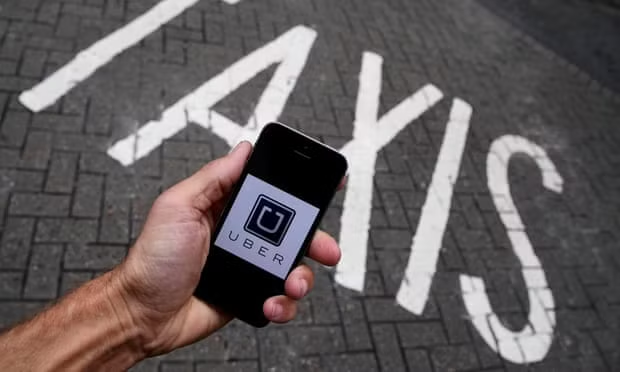
A Transport Workers Union survey found 60% of drivers for rideshare companies such as Uber reported earning below the average hourly $16 rate, before costs such as fuel, insurance and car maintenance. Photograph: Toby Melville/Reuters
 A Transport Workers Union survey found 60% of drivers for rideshare companies such as Uber reported earning below the average hourly $16 rate, before costs such as fuel, insurance and car maintenance. Photograph: Toby Melville/Reuters

“A passenger pinned me into my seat with his body weight while he used a hand to sexually assault me,” one respondent said.

Thirty-seven per cent reported being threatened while almost a third received racist comments.

“I have had drunk passengers call me a nigger and terrorist”, one driver told the survey.

Another driver reported a passenger joked “about taking me to a remote location to rape me”.

One respondent filed a police report after being held at knifepoint, with the rideshare company failing to deactivate the passenger’s accounts.

Drivers also complained of being immediately deactivated from the ride-share apps when passengers leave wallets behind or make false reports.

“Drivers want to be paid a fair rate, we want protections against threats and assaults and we want to go to work and know our company will not sack us without giving us a right of reply,” said the co-operative’s Emmett D’Urso.

The Transport Workers’ Union’s national secretary, Tony Sheldon, said the “shocking and disturbing” survey results revealed the true nature of the on-demand economy, where drivers are being ripped off and forced to struggle.

“They’re offered no support when they face sexual or physical assault and must choose between taking time off work to recover or going back to work the next day in order to get paid,” he said. “They are kicked off the app on a whim of the ride-share companies and prevented from earning a living.

“These survey results expose the lie from the federal government that people can make a fair wage in the on-demand economy. In reality, what’s going on is 18th-century exploitation via an app.”

The survey was conducted between July and October. Respondents, some of whom work for multiple rideshare companies, worked for Uber (97%), Ola (46%), Taxify (26%), DiDi (22%) and others (15%).

Uber, Ola, Taxify and DiDi were contacted for comment.

The Guardian

Other News

AI offers both opportunities, challenges for Vietnam's growth

AI offers both opportunities, challenges for Vietnam's growth

Dr. Ho Duc Thang, a full-time member of the National Assembly’s Committee for Cultural and Educational, said productivity is the key to sustaining double-digit economic growth, and AI has greater potential to improve productivity than any previous technology.

Top leader unveils people-centred vision for new development model

Top leader unveils people-centred vision for new development model

Vietnam's growth model, long fueled by low-cost labour, resource extraction, contract manufacturing, expanded investment, and capital accumulation, has run out of road. The country now needs a sweeping reform agenda to shift from extensive growth to a model driven by productivity, knowledge, science and technology, innovation, and digital transformation.

First national semiconductor chip prototyping support centre makes debut

First national semiconductor chip prototyping support centre makes debut

Vietnam's semiconductor ecosystem now comprises around 60 chip design companies, some 7,000 chip design engineers and 166 universities offering semiconductor-related training programmes. Initial registrations from 12 organisations indicate demand for the prototyping of approximately 30,000 chips.

Vietnam targets at least 10 large strategic technology firms by 2030

Vietnam targets at least 10 large strategic technology firms by 2030

Deputy Prime Minister Ho Quoc Dung has signed a decision approving a plan to develop large domestic strategic technology enterprises in the 2026–2030 period, aimed at advancing digital infrastructure, digital human resources, digital data, strategic technologies and cybersecurity.

Protecting users crucial in building digital trust: Experts

Protecting users crucial in building digital trust: Experts

In Vietnam, digital transformation in the finance and banking sector is accelerating cashless payments, expanding access to financial services, improving market transparency and supporting economic growth and macroeconomic management.

Fostering skilled workforce for innovation era: experts

Fostering skilled workforce for innovation era: experts

Experts said close coordination among State management agencies, research institutes, universities, and businesses will improve training quality and serve the dual goals of quality education and practical research application.

Startup forum bridges Silicon Valley and local innovation ecosystem

Startup forum bridges Silicon Valley and local innovation ecosystem

The University of Economics Ho Chi Minh City (UEH), Saigon Asset Management (SAM), and Plug and Play Tech Centre co-hosted the “From Vietnam to Silicon Valley” forum, exploring AI innovation, venture capital, and pathways to integrate Vietnam’s startup ecosystem with Silicon Valley and global markets.