Uber signs contract with Nasa to develop flying taxi software

Uber has taken a step forward in its plan to make autonomous “flying taxis” a reality, signing a contract with Nasa to develop the software to manage them.

The company’s chief product officer, Jeff Holden, announced the new service contract at Web Summit in Lisbon, alongside its intention to begin testing four-passenger, 200mph UberAir flying taxi services across Los Angeles in 2020, its second test market in the US after Dallas.

Uber said its flying taxi service would be purely electric and that a journey that would take 80 minutes by car in rush-hour traffic could be reduced to as little as four minutes. Uber intends to have some form of its air service operational for the 2028 LA Olympics, but experts remain sceptical as to whether autonomous flying taxis will ever become a reality.
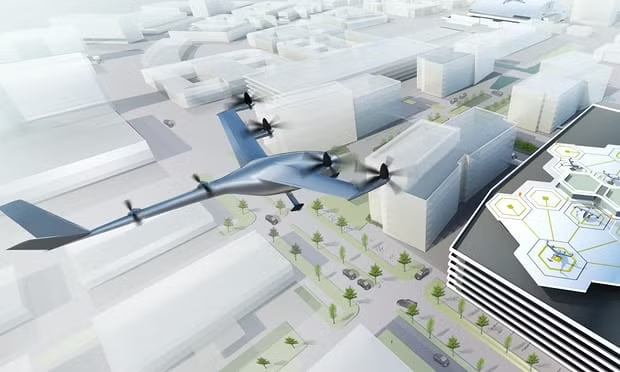
The Space Act agreement, which has been used by Nasa to contract out the development of rockets since the late 1950s, will see Uber participate in a project to develop unmanned traffic management systems as well as the low-altitude unmanned aerial systems (drones) that will be governed by it.

Uber said it did not plan to make the drones itself, instead partnering with five manufacturers that are working on new types of vertical takeoff and landing (VTOL) aircraft. This year Uber hired two Nasa veterans, Mark Moore and Tom Prevot, to run its aircraft vehicle design team and its air traffic management software programme respectively.

Uber has also signed a deal with Sanstone Properties, which has 20 sites across the greater LA area, for plans to build “skyports” that will serve as takeoff and drop-off points for flying taxis.

Such hurdles include the need for approval from the US Federal Aviation Administration for operation outside of normal aircraft corridors, which will be difficult to obtain due to stringent safety and regulation requirements.

Uber has faced endless regulatory and legal battles around the world since it launched its ride-hailing services this decade, including in London where it is battling to retain its licence after having been stripped of it by city regulators over safety concerns.

The firm said it was attempting to change its methods, engaging with regulators in the US and Europe early to win approval for flying taxis. A senior Uber executive told Reuters the company was “very much embracing the regulatory bodies and starting very early in discussions about this and getting everyone aligned with the vision”.

The Guardian

Other News

AI offers both opportunities, challenges for Vietnam's growth

AI offers both opportunities, challenges for Vietnam's growth

Dr. Ho Duc Thang, a full-time member of the National Assembly’s Committee for Cultural and Educational, said productivity is the key to sustaining double-digit economic growth, and AI has greater potential to improve productivity than any previous technology.

Top leader unveils people-centred vision for new development model

Top leader unveils people-centred vision for new development model

Vietnam's growth model, long fueled by low-cost labour, resource extraction, contract manufacturing, expanded investment, and capital accumulation, has run out of road. The country now needs a sweeping reform agenda to shift from extensive growth to a model driven by productivity, knowledge, science and technology, innovation, and digital transformation.

First national semiconductor chip prototyping support centre makes debut

First national semiconductor chip prototyping support centre makes debut

Vietnam's semiconductor ecosystem now comprises around 60 chip design companies, some 7,000 chip design engineers and 166 universities offering semiconductor-related training programmes. Initial registrations from 12 organisations indicate demand for the prototyping of approximately 30,000 chips.

Vietnam targets at least 10 large strategic technology firms by 2030

Vietnam targets at least 10 large strategic technology firms by 2030

Deputy Prime Minister Ho Quoc Dung has signed a decision approving a plan to develop large domestic strategic technology enterprises in the 2026–2030 period, aimed at advancing digital infrastructure, digital human resources, digital data, strategic technologies and cybersecurity.

Protecting users crucial in building digital trust: Experts

Protecting users crucial in building digital trust: Experts

In Vietnam, digital transformation in the finance and banking sector is accelerating cashless payments, expanding access to financial services, improving market transparency and supporting economic growth and macroeconomic management.

Fostering skilled workforce for innovation era: experts

Fostering skilled workforce for innovation era: experts

Experts said close coordination among State management agencies, research institutes, universities, and businesses will improve training quality and serve the dual goals of quality education and practical research application.

Startup forum bridges Silicon Valley and local innovation ecosystem

Startup forum bridges Silicon Valley and local innovation ecosystem

The University of Economics Ho Chi Minh City (UEH), Saigon Asset Management (SAM), and Plug and Play Tech Centre co-hosted the “From Vietnam to Silicon Valley” forum, exploring AI innovation, venture capital, and pathways to integrate Vietnam’s startup ecosystem with Silicon Valley and global markets.