Van Phong Economic Zone poised for takeoff

By 2030, Van Phong aims to rank among Vietnam’s top three economic zones, contributing significantly to provincial and regional GRDP. By 2050, it is envisioned as an international maritime economic centre and a leading driver of Khanh Hoa’s long-term development.
Van Phong Economic Zone poised for takeoff -0
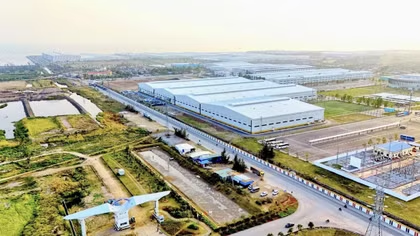
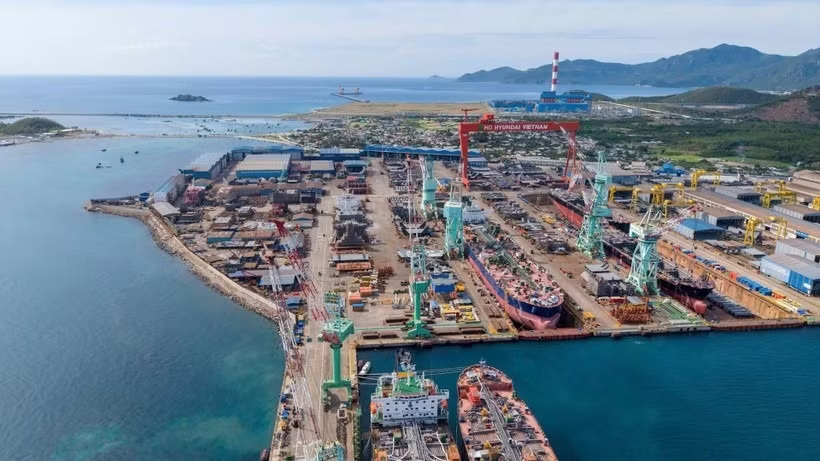
HD Hyundai Vietnam’s shipyard is promoting the development of a logistics and support-service value chain around the Van Phong area. (Photo: nhandan.vn)

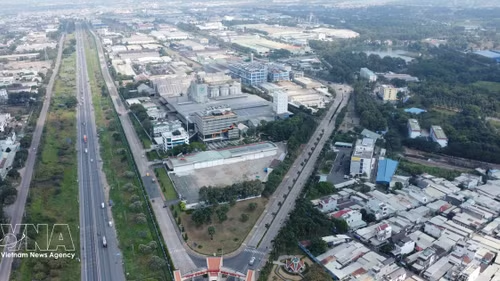
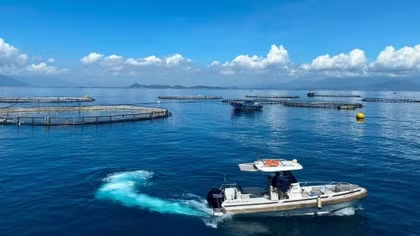
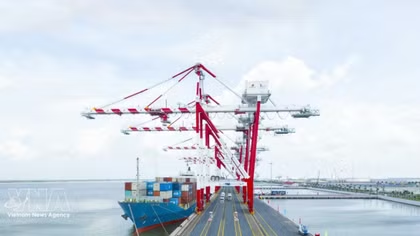
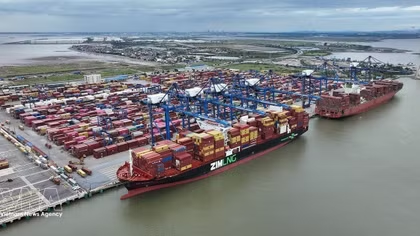
Van Phong in Khanh Hoa province holds a strategic position on international shipping routes, with natural depths of 20–27 metres, sheltered waters, and minimal siltation, ideal conditions for developing into a major international maritime hub.

The Van Phong Economic Zone (EZ), where strategic vision aligns with strong natural advantages, is steadily rising as a key pillar of Vietnam’s maritime economy.

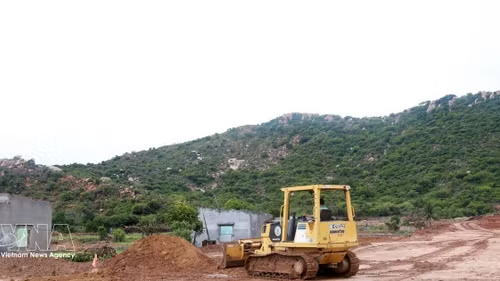
The master plan for the EZ through 2040, with a vision to 2050, sets out a dual development model - the northern area will become a modern coastal tourism city with international-standard services and a duty-free zone, while the southern corridor will evolve into a hub for industry, energy, logistics, and deep-water ports, complemented by a chain of sustainable coastal urban areas.To realise this vision, Khanh Hoa is accelerating investment in regional and port-linking infrastructure.

Major projects, including the Van Phong–Nha Trang expressway section, the Van Gia–Tu Bong–Dam Mon coastal road, upgrades to National Route 1A, and improvements to the North–South railway, will form an integrated transport network that strengthens logistics capacity and investment appeal.According to provincial leaders, infrastructure remains the decisive factor enabling Van Phong International Port to serve as a gateway connecting Vietnam’s maritime trade with global markets.

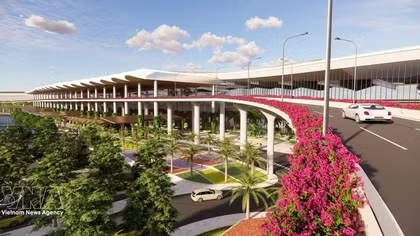
Utilities and urban infrastructure across the EZ are being planned in parallel. The province is also promoting public–private partnerships to mobilise resources for ports, renewable energy, and resettlement areas. Key subzone plans are expected to be completed by 2026, creating a strong legal foundation and a supply of clean, well-located land for strategic investors. The planned addition of Van Phong Airport is expected to accelerate development.

The latest planning framework aims to build a modern, green, and integrated economic zone capable of attracting major investors in ports, logistics, and heavy industry, while also developing international-standard tourism and coastal urban centres.

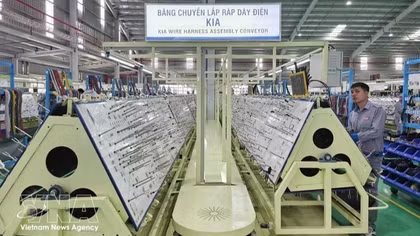
Van Phong EZ has so far attracted more than 150 projects with a total registered capital of approximately 5.4 billion USD.

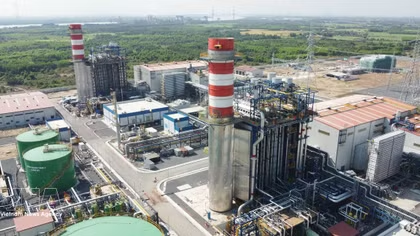
Many large-scale investments are already operational, including the Van Phong 1 Thermal Power Plant (2.58 billion USD), HD Hyundai Vietnam Shipyard ( 350 million USD), and Australis Vietnam Limited ( 68.19 million USD). These projects generate economic value, create jobs, and stimulate logistics and service chains around the zone.

In 2025, two major urban developments will give Van Phong additional momentum, including the Tu Bong high-end urban area (over 43 trillion VND - 1.63 million USD), envisioned as the northern coastal city centre, and the Dam Mon high-end urban area (over 25.6 trillion VND), designed as a core urban hub for commerce, tourism, and international finance.

A series of large tourism and service projects, such as Hon Ngang Ecotourism, Co Ma Urban Area, and Doc Let–Phuong Mai Resort, are also being advanced, forming a modern and cohesive coastal urban chain.

Backed by national-level resolutions granting special mechanisms in finance, investment, land management, and decentralisation, Khanh Hoa is prioritising three breakthrough areas: development of strategic infrastructure; administrative reform and digital transformation to streamline licensing; and faster land clearance to prepare clean land for large projects, particularly in clean industry, high technology, green energy, and ecotourism.

Local authorities emphasised that boosting the investment climate, enhancing the competitiveness index, and providing transparent, timely support for investors are key priorities.

Sustainability is also a major focus, with plans incorporating green economy initiatives, climate adaptation strategies, circular economy models, and clean energy into the overall development approach.

By 2030, Van Phong aims to rank among Vietnam’s top three economic zones, contributing significantly to provincial and regional GRDP. By 2050, it is envisioned as an international maritime economic centre and a leading driver of Khanh Hoa’s long-term development.
VNA

Other News

SBV raises short-term capital lending cap to 40%

SBV raises short-term capital lending cap to 40%

The new circular will help credit institutions have more room to provide capital to businesses and investment projects to support high economic growth in the next few years, while increasing flexibility in the SBV’s monetary policy management.

Business confidence in Vietnam rebounds strongly: UOB

Business confidence in Vietnam rebounds strongly: UOB

The study found that 85% of Vietnamese enterprises reported positive business sentiment, a sharp increase from 48% in 2025, when business confidence was weighed down by uncertainties surrounding US tariff policies and related trade developments.

Bac Ninh seeks high-quality foreign investment for sustainable growth

Bac Ninh seeks high-quality foreign investment for sustainable growth

According to Vice Chairman of the provincial People’s Committee Pham Van Thinh, the province aims to maintain stable and sustainable growth, improve the competitiveness of both the economy and local businesses, and make better use of free trade agreements (FTAs) to expand and diversify export markets.

Green building trend flourishes in Ho Chi Minh City's real estate landscape

Green building trend flourishes in Ho Chi Minh City's real estate landscape

The International Finance Corporation (IFC) highlighted the city's dominance in green-certified building floor space in Vietnam, reflecting the rapid expansion of the green building market with 780 completed green buildings encompassing over 18.69 million sq.m by 2025, predominantly certified by EDGE and LEED.

UK supports Vietnam in wind power and green finance development

UK supports Vietnam in wind power and green finance development

The United Kingdom officially announced two new climate cooperation initiatives to support Vietnam in its energy transition and green growth journey. These programs focus on offshore wind power development and the creation of a sustainable green financial ecosystem.

Ample room remains for Vietnam–India logistics cooperation

Ample room remains for Vietnam–India logistics cooperation

The GTTCI expert noted that alongside logistics and integrated warehousing, e-commerce is expected to be a particularly high-growth sector in the coming years. He described it as a multi-billion-dollar market with significant untapped opportunities for cooperation between Vietnam and India.

Exports gain momentum from high-tech growth drivers

Exports gain momentum from high-tech growth drivers

According to the Ministry of Industry and Trade, Vietnam’s exports reached 215.66 billion USD in the first five months of 2026, up 19.5% year-on-year. Twenty-six export items generated more than 1 billion USD in revenue each, including seven with turnover exceeding 10 billion USD.

Vietnam–China crossings see spike in ASEAN fresh produce

Vietnam–China crossings see spike in ASEAN fresh produce

Since the start of the summer harvest season, China's two major border gates with Vietnam, Youyi Guan in Pingxiang and Beilun 2 Bridge in Dongxing, have entered their peak period for handling imports of fresh agricultural and seafood products from member states of the Association of Southeast Asian Nations (ASEAN).

Cargo handling operations at Berths 3 and 4 of the Hai Phong International Gateway Port. (Photo: VNA)

AI reshapes logistics, raising bar for workforce skills

According to the Vietnam Logistics Business Association (VLA), the logistics sector will require around 2.2 million workers by 2030, including 1.6 million employees for logistics service providers and nearly 600,000 personnel supporting logistics operations in manufacturing and trading enterprises.

Robust dispute resolution framework key to Vietnam's IFC ambitions

Robust dispute resolution framework key to Vietnam's IFC ambitions

The development strategy for VIFC-HCMC envisions a comprehensive financial ecosystem encompassing green finance, carbon credits, financial technology (fintech), blockchain technology, digital assets, digital banking and other innovative business models. These highly internationalised sectors involve complex cross-border transactions and sophisticated legal structures.