Vietnam seeks to further develop digital economy

 The prerequisite for Vietnam's digital economy to go further is to optimise modern scientific and technological advancements in accordance with Vietnam's own approach, according to Nguyen Trung Chinh, Chairman of the Board of Directors and Executive President of CMC Corporation.

According to experts from the Commonwealth Scientific and Industrial Research Organisation (CSIRO), digital transformation will bring about a 1.1% annual increase in GDP growth for Vietnam.

The experts held that the challenge for domestic technology businesses is how to learn, update and leverage the advantages of the global IT industry, and at the same time strive to produce made-in-Vietnam high-quality technology products and services led by Vietnamese people.

The Government’s recent digital transformation efforts, including the establishment of the National Public Service Portal and the Government Reporting Information System, have proved effective, saving time and costs for citizens and businesses, while contributing to preventing corruption.

Vietnam seeks to further develop digital economy -0
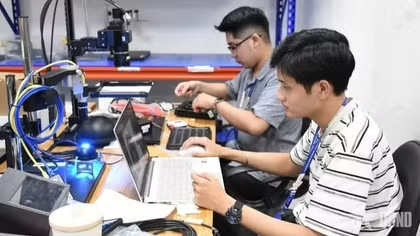
Illustrative image (Source: Vietnamnet.vn)

According to the draft National Digital Transformation Programme, Vietnam aims to enter the top 50 countries in e-government and ensure that the digital economy accounts for 30% of the country's GDP by 2030.

Chinh underlined that to this end, the Government, the Ministry of Information and Communications and IT companies should work closely together to build a strong national digital infrastructure system, including the hard system comprising 5G services, and data connectivity and storage, as well as the soft system of national database and open data.

The Government should promptly issue a set of common standards for the national population database and data for particular sectors, he said.

Chinh said that the Government can coordinate with IT firms to speed up the implementation and popularisation of shared platforms in order to optimise costs, diversify and maximise information sources and support businesses’ operations.

The expert also underlined the need for an institution infrastructure with policies matching the digital society.

Consistent policies and regulations are also necessary to shape the digital economy, including those related to cross-border data flows, data security, cybersecurity, customer protection, e-commerce and taxation, he added.

Many experts asserted that initially, the Government should continue to complete the institutions, policies and legal corridors regarding information security, cybersecurity, cybercrime, and the protection of children on the cyberspace, as well as human resources in the field.

In the long run, the Government can collaborate with IT companies to establish a cybersecurity cooperation centre, aiming to coordinate cyberspace security, giving cyber-attack alerts, and participating in joint cyber defence exercises. The centre can also give training courses to enhance the capacity of officials in the field of cybersecurity and safety, they added.

According to Chinh, the Government should open the door wider for technology businesses to attract talents and resources. At the same time, it should delegate projects related to the country's digital infrastructure such as data centres, telecommunications infrastructure, and smart cities, to the private sector, he said, adding that Vietnam should turn itself into a Digital Hub for the Asia-Pacific region, serving as a central point for data transfer and telecommunications infrastructure connectivity in the region.

VNA

Other News

Hanoi approves controlled pilot of two technology projects

Hanoi approves controlled pilot of two technology projects

The two projects involve an intelligent autonomous transportation system developed by Phenikaa-X JSC and a technology for producing mixed rare-earth oxides with a purity of over 95% on a semi-industrial scale developed by the Mining Technology and Construction Consultancy JSC.

Banking industry in AI era: When data becomes competitive advantage

Banking industry in AI era: When data becomes competitive advantage

In just a few years, AI has evolved from an experimental technology into an “assistant” for many banks, supporting everything from customer service, credit approval, and fraud detection to risk management. However, as the technological gap between institutions narrows, a new question is emerging: What will determine banks' competitive advantage in the AI era?

Bac Ninh considers establishing AI centre of excellence

Bac Ninh considers establishing AI centre of excellence

A meeting has been held in Bac Ninh to discuss potential cooperation with Plug and Play in developing the northern province’s innovation ecosystem and establishing an artificial intelligence (AI) centre of excellence, with Standing Vice Chairman of the provincial People’s Committee Mai Son receiving a delegation from the global innovation platform.

Hanoi allows 24-month trial of autonomous vehicles at Hoa Lac

Hanoi allows 24-month trial of autonomous vehicles at Hoa Lac

The project aims to assess the safety, reliability and readiness of autonomous vehicles under real traffic conditions, as well as the effectiveness of autonomous public transport and compatibility with existing systems. Its results will contribute to developing technical standards, operating procedures and management models suited to Hanoi’s traffic conditions.

Singapore's experience suggests solutions to Vietnam's human resources challenge in AI era

Singapore's experience suggests solutions to Vietnam's human resources challenge in AI era

As Vietnam accelerates digital transformation and high-tech development, Singapore’s experience and the engagement of global technology companies demonstrate that human resources preparation must stay ahead of the curve. The ability to filter knowledge, collaborate, innovate and effectively use AI will increasingly become essential to helping workers adapt to a changing labour market and strengthening the competitiveness of Vietnam’s economy in the new era.

Protecting national security amid digital transformation, cyberspace

Protecting national security amid digital transformation, cyberspace

Cybersecurity, information security and data security risks must be identified and addressed early and from afar, with appropriate defensive measures ready to neutralise threats and protect national interests in cyberspace, said Lieutenant General Le Xuan Minh, Director of the Ministry of Public Security’s Department of Cybersecurity and Hi-tech Crime Prevention (A05).

Mekong Delta launches first robotics, AI research institute

Mekong Delta launches first robotics, AI research institute

Dr. Nguyen Van Quang, Rector of Nam Can Tho University, said the university is developing a value chain covering training, research, technology development, testing, technology transfer and commercialisation. The model is designed to link research more closely with practical needs, ensuring that technologies generate products and products create value for society.

Vietnam positioned to harness AI wave, World Bank report says

Vietnam positioned to harness AI wave, World Bank report says

The WB report identifies Vietnam as one of the few economies outside the European Union (EU) to have adopted a comprehensive AI regulatory framework as early as 2025. Vietnam applies a risk-tiered approach similar to that of the EU AI Act, imposing different obligations depending on whether an AI system poses “unacceptable,” “high,” “low” or “minimal” risks. The approach is viewed as a strategic step towards ensuring safe and transparent AI governance.

AI offers both opportunities, challenges for Vietnam's growth

AI offers both opportunities, challenges for Vietnam's growth

Dr. Ho Duc Thang, a full-time member of the National Assembly’s Committee for Cultural and Educational, said productivity is the key to sustaining double-digit economic growth, and AI has greater potential to improve productivity than any previous technology.

Top leader unveils people-centred vision for new development model

Top leader unveils people-centred vision for new development model

Vietnam's growth model, long fueled by low-cost labour, resource extraction, contract manufacturing, expanded investment, and capital accumulation, has run out of road. The country now needs a sweeping reform agenda to shift from extensive growth to a model driven by productivity, knowledge, science and technology, innovation, and digital transformation.