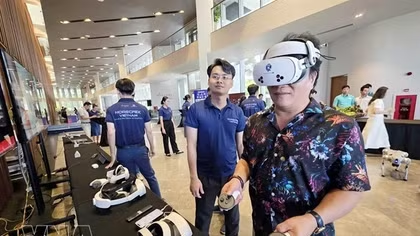
An array of telecommunication firms have been licensed to provide services based on the new technology, which, according to experts, has brought operators back to the starting line and offers an opportunity for many carriers to make breakthroughs.
New opportunity, new battle

In late October, Minister of Information and Communications Truong Minh Tuan licensed four telecommunication carriers, including Viettel, VinaPhone, MobiFone and Gmobile, to establish the network and provide 4G LTE-Advanced public land mobile telecommunication services. After nearly a year of trials, these operators have officially been permitted to offer 4G services.
As commented by many experts, Vietnam’s telecommunication market has become saturated with the number of mobile subscribers exceeding the population. Meanwhile, the three largest operators are accounting for about 95% of market shares. Given that fact, 4G will be an opportunity for both large and small-sized mobile network carriers to change the current market share balance.
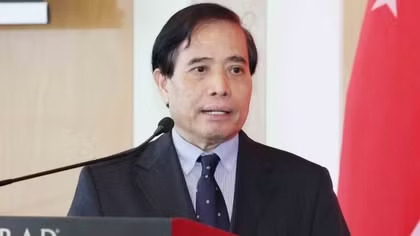
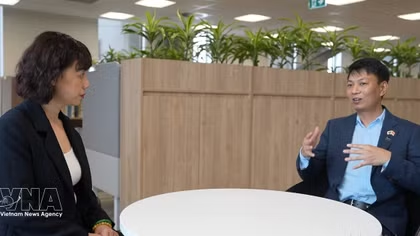
Luong Manh Hoang, chief executive officer of VNPT-VinaPhone (under the Vietnam Post and Telecommunications Group - VNPT), said that VNPT identified 4G as an opportunity for breakthroughs, serving the short-term goal of reclaiming the firm’s second place in the mobile network market with about 33% of subscriber market shares. 4G puts all operators on the same starting line and success will come to those who make the best use of the opportunities offered.
VNPT has demonstrated its determination by officially commercialising 4G just one week after being granted with the license. Chairman of the Council of Members of VNPT Tran Manh Hung revealed that VNPT piloted 4G services on Phu Quoc Island in the Mekong Delta province of Kien Giang and several districts of Ho Chi Minh City from January 2016. As seen through the results, the transmission speed of 4G was equivalent to that of the current cable services offered to customers by operators.
On par with the testing process, VNPT has also remained ready and made organised preparations in terms of both the network and services, towards officially providing the best 4G services for customers, creating a new breakthrough in telecom services and information technology. Therefore, just one week after receiving the license, from November 3, VNPT is officially offering 4G services on Phu Quoc Island to service locals and tourists.
In 2017, the firm is targeting to implement 21,000 4G stations aiming to extend its wave coverage to all districts across the country. In the following years, VNPT plans to continue expanding and increasing the number of 4G stations as well as applying technological advances, seeking to have 100% 4G coverage in big cities and provinces and 85% on average nationwide.
Unlike VNPT, Vietnam’s military-run mobile firm Viettel wants to focus its efforts on a full-scale campaign. As released by Viettel Deputy General Director Hoang Son, the corporation looks towards widespread 4G coverage right from the beginning. Viettel plans to implement 4G services with the most widespread coverage throughout the country in the shortest period of time, as they did with the 2G network previously, aiming to offer the mobile broadband service to all.
Numerous challenges
For a developing nation like Vietnam, the popularisation of the mobile broadband holds significant meaning and brings about a lot of opportunities. According to global statistics, the gross domestic product (GDP) of a nation will increase by 1% if the broadband grows by 10%.
However, it will be both difficult and time-consuming to bring the broadband to all Vietnamese households by cable owing to access devices and access costs. Meanwhile, the 4G technology allows us to rapidly popularise mobile broadband among the majority of mobile users, which will give a boost to the country’s GDP and socio-economic development as well as lift Vietnam’s telecom ranking up on the world telecom map.
However, the commercialisation of 4G not only generates opportunities but also poses numerous challenges to network operators. The payback plan needs to be thoroughly calculated as it bears a close relation to the implementation plan of each enterprise. The carriers will have to choose between rapid payback by implementing services in big cities and slow payback by large-scale implementation.
Regardless of the measure they choose, it is clear that 4G is not a worthwhile risk for financially weak operators. Former Deputy Minister of Information and Communications Le Nam Thang noted that the current prices of 4G endpoints is relatively high compared to Vietnam’s general income level, which will make it difficult for the 4G commercialisation process to attract a majority of users. In addition, the quality of services should also be focused on by mobile network carriers.
In fact, the optimal speed of 3G could reach over 40 megabytes per seconds, but the average 3G speed currently offered by Vietnam’s operators is only 1.5 megabytes per second and is very instable. Therefore, with 4G, operators need to focus investment in network infrastructure, aiming to ensure that the provided services will follow through with superior quality as promised.
VNPT-VinaPhone CEO Luong Manh Hoang said that alongside ensuring network infrastructure, VNPT identifies appropriate services and packages as a key point to make 4G attractive to consumers. As a result, the firm has promptly got down to researching favoured services and utilities based on 4G technology that meet Vietnam’s specific features and bring in numerous benefits for consumers, thus helping VNPT storm ahead in the race against other operators.
As shown by statistics, 521 operators in the world had successfully commercialised the 4G network in 170 countries by the end of July 2016. The number of 4G subscribers also grew to 1.45 billion, accounting for nearly 20% of the total 7.46 billion global mobile subscribers. 4G is predicted to generate US$600 billion in revenue this year, and the figure is expected to increase quickly as this technology’s penetration will grow about 30% in 2017.