Facial matching system risks racial bias, Human Rights Law Centre warns

Facial matching technology proposed by the government risks racial bias and would have a chilling effect on the right to freedom of assembly without further safeguards, the Human Rights Law Centre has said.

The warning is contained in a submission to a parliamentary committee inquiry examining the Coalition’s proposal for the home affairs department to collect, use and disclose facial identification information.

The facial matching system was agreed to in principle by states in October, but has since led to overreach warnings from Victoria and the Law Council of Australia.

Concerned parties have warned the Coalition’s identity matching services bill allows access to facial verification data by the private sector and local governments, and that it could be used to prosecute low-level crimes.
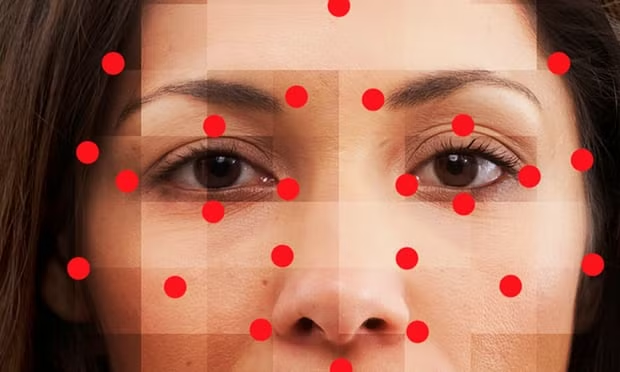
Ethnic minorities could be ‘disproportionally’ targeted by the government’s facial matching system. Photograph: John Lund/Getty Images/Blend Images

In a submission to the parliamentary joint committee on intelligence and security, lodged on Tuesday, the Human Rights Law Centre warned the bill was “manifestly and dangerously insufficient” and the system was “high risk” because the bill failed to adequately identify or regulate the uses of facial matching technology.

The centre submitted that both false positive and false negative results for facial recognition “are likely to arise disproportionately in relation to people who belong to ethnic minorities in Australia”.

It cited studies that found facial recognition had “a bias towards the dominant ethnic group in the area in which it is developed”.

The HRLC noted the NEC Neoface technology, used by federal agencies and several Australian states, had been validated as the best in the industry by the US National Institute of Standards and Technology.

But the centre warned the technology “has not been tested for accuracy based on demographics”, and therefore overall accuracy rates may obscure disproportionately high rates of misidentification of ethnic minorities.

The centre warned that false positives could subject suspects to investigation, surveillance and denial of employment, and misidentification would erode trust in law enforcement and security agencies. It recommended annual accuracy testing, including demographic tests.

The use of facial recognition technologies also posed “a significant threat to freedoms of expression, association and assembly”, the submission said.

It said facial recognition “risks transforming the public space into a sphere where each person can be monitored and identified”, which is “particularly concerning in the context of civic gatherings, demonstrations and protests”.

The HRLC said the use of facial recognition could discourage people from exercising their right to assembly, because even citizens who had done nothing wrong might not want police to know they had attended politically sensitive gatherings such as protests against police violence or Aboriginal deaths in custody.

It said “politically motivated surveillance” might not be a “likely near-term consequence” of the bill, but it “must be guarded against in the design of this system”. It said the bill should not pass without safeguards to protect freedom of expression.


The Guardian

Other News

SK Group partners to build AI ecosystem in Vietnam

SK Group partners to build AI ecosystem in Vietnam

SK Innovation and SK Telecom signed MoUs with Nghe An province and the National Innovation Centre of Vietnam to advance AI ecosystem development and support the country’s long-term growth strategy.

Vietnam Research Excellence Fellowship for 2026-2030 approved

Vietnam Research Excellence Fellowship for 2026-2030 approved

Under the Vietnam Research Excellence Fellowship (VREF) for the 2026–2030 period, PhD students are identified as a core research force directly contributing to breakthroughs in sci-tech and innovation. Investing in top-tier doctoral candidates is more than workforce development, but a high-stakes strategic bet to forge a cohort of world-class scientists and technologists who can power Vietnam’s long-term economic ambitions.

Strategic tech must address practical challenges: PM

Strategic tech must address practical challenges: PM

Prime Minister Pham Minh Chinh on March 28 said strategic technologies must tackle Vietnam’s practical challenges, while chairing a meeting of the Government’s Steering Committee for science and technology, innovation, digital transformation, and Project 06.

Ho Chi Minh City sets sights on becoming semiconductor hub

Ho Chi Minh City sets sights on becoming semiconductor hub

Ho Chi Minh City is stepping up efforts to attract investment from global leading groups and companies in the fields of electronic components, semiconductors and chip manufacturing as it seeks to position itself as a leading semiconductor industry hub in both the region and the world. 

Ho Chi Minh City launches upgraded technology exchange platform

Ho Chi Minh City launches upgraded technology exchange platform

The upgraded platform represents a comprehensive shift from a simple information-sharing model to a managed online technology trading system, enabling monitoring and measurement of real transaction outcomes. It is built on three pillars, namely new tradable technology products, a modern digital platform, and an improved operational model.

AI – unmissable opportunity for Vietnam: Experts

AI – unmissable opportunity for Vietnam: Experts

AI also emerges as a key enabler for Vietnam's ambition to build financial and technology hubs. Applications can boost efficiency, automate workflows, cut costs, and sharpen data analytics, which are essential pillars of a modern financial system.

PM calls for accelerated space technology development in Vietnam

PM calls for accelerated space technology development in Vietnam

Vietnam aims by 2030 to achieve a mid-level position in space science and technology development within Southeast Asia, and after 2030 to build national capabilities to independently develop satellite technologies and apply space data to address global challenges and national security needs.

High-level forum advances Vietnam–US technological cooperation

High-level forum advances Vietnam–US technological cooperation

A high-level executive leadership forum focusing on strengthening Vietnam - US relations through technology cooperation was jointly held in Washington D.C. on March 11 by the Embassy of Vietnam in the US, the Weatherhead East Asian Institute of Columbia University, and the US -ASEAN Business Council (USABC). 

AI Law takes effect, anchors national governance framework

AI Law takes effect, anchors national governance framework

While many countries are still drafting policy blueprints or issuing non-binding guidance, Vietnam has moved ahead with a standalone Law on Artificial Intelligence (AI), effective from March 1, placing it among a select group of nations to adopt dedicated AI legislation at the parliamentary level. 

Vietnam International Defence Expo 2026 preparations move into high gear

Vietnam International Defence Expo 2026 preparations move into high gear

Vietnam International Defence Expo 2026, themed “Peace, Friendship, Cooperation and Development,” will be organised on a larger scale, featuring a wide array of weapons and technical equipment alongside product exhibitions, seminars and panel discussions, drills, live field demonstrations, and business networking activities.

Ministry requests urgent measures to counter UAVs threatening aviation safety

Ministry requests urgent measures to counter UAVs threatening aviation safety

Ministry of Construction requested the Ministry of National Defence, the Ministry of Public Security and provincial and municipal steering committees for counter-terrorism to strengthen the management, inspection and supervision of UAVs and other aerial devices, ensuring strict compliance with Decree No. 288/2025/ND-CP and relevant legal regulations.