Silicon Valley startup peddles 3D-printed bike

After a career that included helping Alphabet Inc’s Google build out data centers and speeding packages for Amazon.com Inc to customers, Jim Miller is doing what many Silicon Valley executives do after stints at big companies: finding more time to ride his bike.

But this bike is a little different. Arevo Inc, a startup with backing from the venture capital arm of the Central Intelligence Agency and where Miller recently took the helm, has produced what it says is the world’s first carbon fiber bicycle with 3D-printed frame.

Arevo is using the bike to demonstrate its design software and printing technology, which it hopes to use to produce parts for bicycles, aircraft, space vehicles and other applications where designers prize the strength and lightness of so-called “composite” carbon fiber parts but are put off by the high-cost and labor-intensive process of making them.
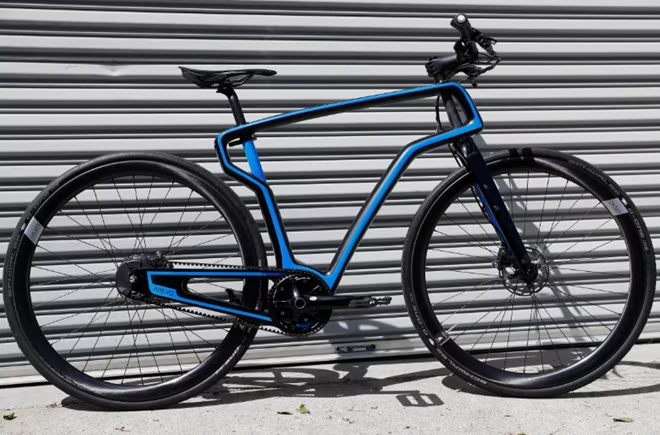
A 3D-printed carbon fiber commuter bicycle by Arevo Labs is seen in Santa Clara, California, May 10, 2018. REUTERS/ Stephen Lam

Arevo on Thursday raised $12.5 million in venture funding from a unit of Japan’s Asahi Glass Co Ltd, Sumitomo Corp’s Sumitomo Corp of the Americas and Leslie Ventures. Previously, the company raised $7 million from Khosla Ventures, which also took part in Thursday’s funding, and an undisclosed sum from In-Q-Tel, the venture capital fund backed by the CIA.

Traditional carbon fiber bikes are expensive because workers lay individual layers of carbon fiber impregnated with resin around a mold of the frame by hand. The frame then gets baked in an oven to melt the resin and bind the carbon fiber sheets together.
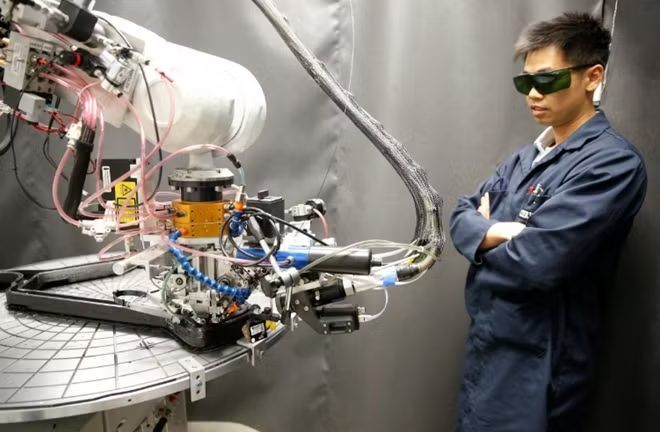
Chris Lee, an engineer at Arevo Labs, watches a 3D-printing robot print a bicycle frame in Santa Clara, California, May 10, 2018. REUTERS/ Stephen Lam

Arevo’s technology uses a “deposition head” mounted on a robotic arm to print out the three-dimensional shape of the bicycle frame. The head lays down strands of carbon fiber and melts a thermoplastic material to bind the strands, all in one step.

The process involves almost no human labor, allowing Arevo to build bicycle frames for $300 in costs, even in pricey Silicon Valley.

“We’re right in line with what it costs to build a bicycle frame in Asia,” Miller said. “Because the labor costs are so much lower, we can re-shore the manufacturing of composites.”

While Miller said Arevo is in talks with several bike manufacturers, the company eventually hopes to supply aerospace parts. Arevo’s printing head could run along rails to print larger parts and would avoid the need to build huge ovens to bake them in.

“We can print as big as you want - the fuselage of an aircraft, the wing of an aircraft,” Miller said.

Reuters

Other News

SK Group partners to build AI ecosystem in Vietnam

SK Group partners to build AI ecosystem in Vietnam

SK Innovation and SK Telecom signed MoUs with Nghe An province and the National Innovation Centre of Vietnam to advance AI ecosystem development and support the country’s long-term growth strategy.

Vietnam Research Excellence Fellowship for 2026-2030 approved

Vietnam Research Excellence Fellowship for 2026-2030 approved

Under the Vietnam Research Excellence Fellowship (VREF) for the 2026–2030 period, PhD students are identified as a core research force directly contributing to breakthroughs in sci-tech and innovation. Investing in top-tier doctoral candidates is more than workforce development, but a high-stakes strategic bet to forge a cohort of world-class scientists and technologists who can power Vietnam’s long-term economic ambitions.

Strategic tech must address practical challenges: PM

Strategic tech must address practical challenges: PM

Prime Minister Pham Minh Chinh on March 28 said strategic technologies must tackle Vietnam’s practical challenges, while chairing a meeting of the Government’s Steering Committee for science and technology, innovation, digital transformation, and Project 06.

Ho Chi Minh City sets sights on becoming semiconductor hub

Ho Chi Minh City sets sights on becoming semiconductor hub

Ho Chi Minh City is stepping up efforts to attract investment from global leading groups and companies in the fields of electronic components, semiconductors and chip manufacturing as it seeks to position itself as a leading semiconductor industry hub in both the region and the world. 

Ho Chi Minh City launches upgraded technology exchange platform

Ho Chi Minh City launches upgraded technology exchange platform

The upgraded platform represents a comprehensive shift from a simple information-sharing model to a managed online technology trading system, enabling monitoring and measurement of real transaction outcomes. It is built on three pillars, namely new tradable technology products, a modern digital platform, and an improved operational model.

AI – unmissable opportunity for Vietnam: Experts

AI – unmissable opportunity for Vietnam: Experts

AI also emerges as a key enabler for Vietnam's ambition to build financial and technology hubs. Applications can boost efficiency, automate workflows, cut costs, and sharpen data analytics, which are essential pillars of a modern financial system.

PM calls for accelerated space technology development in Vietnam

PM calls for accelerated space technology development in Vietnam

Vietnam aims by 2030 to achieve a mid-level position in space science and technology development within Southeast Asia, and after 2030 to build national capabilities to independently develop satellite technologies and apply space data to address global challenges and national security needs.

High-level forum advances Vietnam–US technological cooperation

High-level forum advances Vietnam–US technological cooperation

A high-level executive leadership forum focusing on strengthening Vietnam - US relations through technology cooperation was jointly held in Washington D.C. on March 11 by the Embassy of Vietnam in the US, the Weatherhead East Asian Institute of Columbia University, and the US -ASEAN Business Council (USABC). 

AI Law takes effect, anchors national governance framework

AI Law takes effect, anchors national governance framework

While many countries are still drafting policy blueprints or issuing non-binding guidance, Vietnam has moved ahead with a standalone Law on Artificial Intelligence (AI), effective from March 1, placing it among a select group of nations to adopt dedicated AI legislation at the parliamentary level. 

Vietnam International Defence Expo 2026 preparations move into high gear

Vietnam International Defence Expo 2026 preparations move into high gear

Vietnam International Defence Expo 2026, themed “Peace, Friendship, Cooperation and Development,” will be organised on a larger scale, featuring a wide array of weapons and technical equipment alongside product exhibitions, seminars and panel discussions, drills, live field demonstrations, and business networking activities.

Ministry requests urgent measures to counter UAVs threatening aviation safety

Ministry requests urgent measures to counter UAVs threatening aviation safety

Ministry of Construction requested the Ministry of National Defence, the Ministry of Public Security and provincial and municipal steering committees for counter-terrorism to strengthen the management, inspection and supervision of UAVs and other aerial devices, ensuring strict compliance with Decree No. 288/2025/ND-CP and relevant legal regulations.